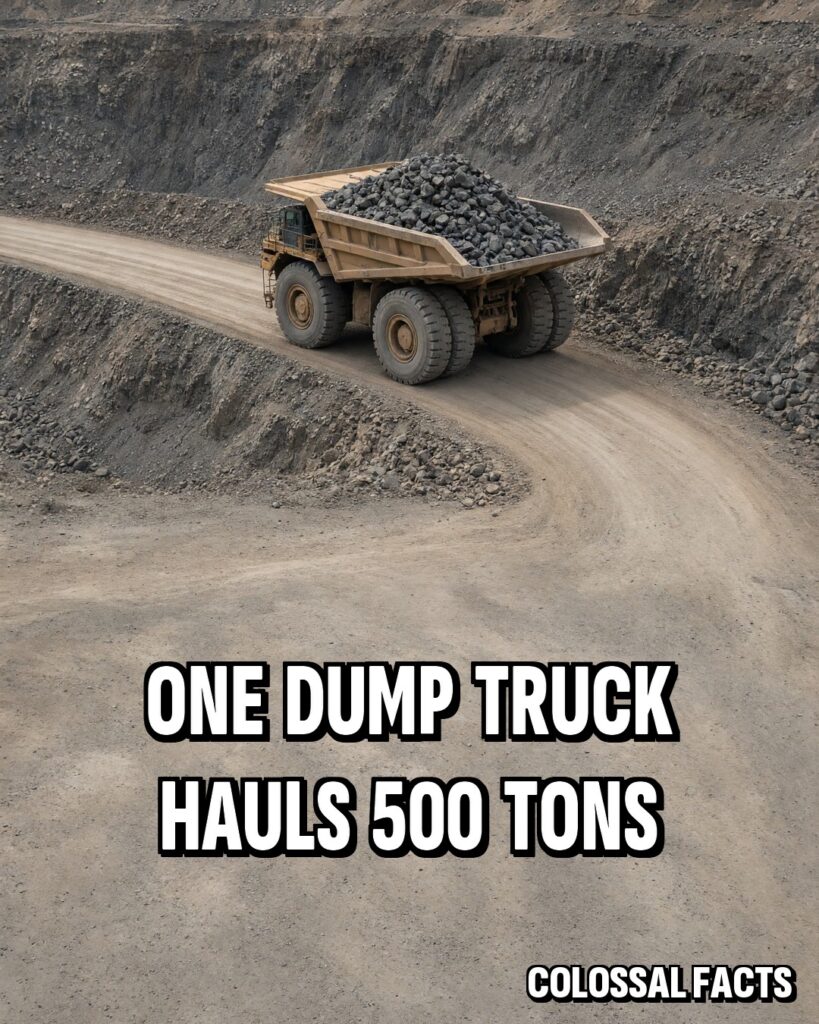
The BelAZ 75710 is a mining dump truck built by the Belarusian company BelAZ. In plain words, it is a hauler that carries broken rock out of an open-pit mine. Its payload, the load it is rated to carry, is 450 metric tonnes (about 500 US tons), among the highest of any production dump truck. With that rock in the bed, the full weight of truck plus load reaches about 810 metric tonnes (893 US tons). The truck is far too large for ordinary roads. A public highway is not built for a machine of this size or this axle load. That is why it never drives to the job from a factory gate in the usual way. Crews move it in parts and assemble those parts in workshops at the mine, on the same ground where the truck will spend its working life.
The first examples were built in the 2010s for huge coal and ore pits, including mines in Russia. The design uses a diesel-electric layout and eight wheels, so the 450-tonne load is spread in a way a smaller four-wheel hauler could not manage. After the first truck finished its service, in the autumn of 2023, it was moved to a museum complex in Verkhnyaya Pyshma, in Russia’s Sverdlovsk Region, where oversized industrial machines are put on display.
A bed for 300 cars, and no public road
What about those 450 metric tonnes? They match about 300 cars of roughly 1.5 tonnes (3,300 pounds) each, loaded at once into a single bed. The comparison is only a scale check, but it is why the truck exists: in a pit, one machine that can take 300 cars’ worth of rock in a single climb out of the hole is cheaper than a long queue of ordinary dumpers. Three hundred cars sit, in that sense, in one bed. The truck that holds them still cannot take a normal road, and it never will. Its world is the mine floor, the workshop that assembled it, and, for the first of the type, a museum yard.
Built in Belarus, assembled at the pit
BelAZ, based in Zhodino, has long built heavy haulers for mines in the former Soviet Union and beyond. The 75710 was announced as a jump past the 360-tonne class that had been the usual ceiling. Two diesel engines and a set of electric drives give it the power to climb out of a pit with 450 tonnes in the bed, and the eight-wheel layout spreads a gross weight of more than 800 tonnes so that the tires and the haul road can survive the trip. None of that works on a public highway, which is why a 75710 is a kit until it reaches the mine, and a museum piece only after a special move.
The 300-car comparison is a way to feel the payload, not a claim that anyone would load automobiles into the bed. In the pit the cargo is ore or overburden, moved in a cycle of loading, climbing, dumping, and coming back down. When the first truck’s working life ended, the museum at Verkhnyaya Pyshma — already a home for oversized Soviet and Russian machines — was a logical place to put it. Three hundred cars’ worth of rock in one bed is the point of the design. The truck that holds them still cannot take a normal road, and its last stop, for that first example, was a museum floor instead of a highway.
In the pit, that payload is a normal shift’s work, not a stunt. On any public road, the same machine would be impossible. The BelAZ 75710 is a tool for the mine, and only afterward, for one retired example, a museum exhibit.
Sources: BelAZ official site, BelAZ 75710 – Wikipedia, Museum of military and automotive equipment, Verkhnyaya Pyshma