Between 1942 and 1977, ranger Roy Cleveland Sullivan of Shenandoah National Park in Virginia was struck by lightning seven times. He survived every hit. Guinness World Records recognizes him as the person struck more recorded times than any other human. The documented years were 1942, 1969, 1970, 1972, 1973, 1976, and 1977. He was a park ranger, outdoors in a mountain range that sees frequent summer storms, which is part of why the tally could climb so high and still be recorded.
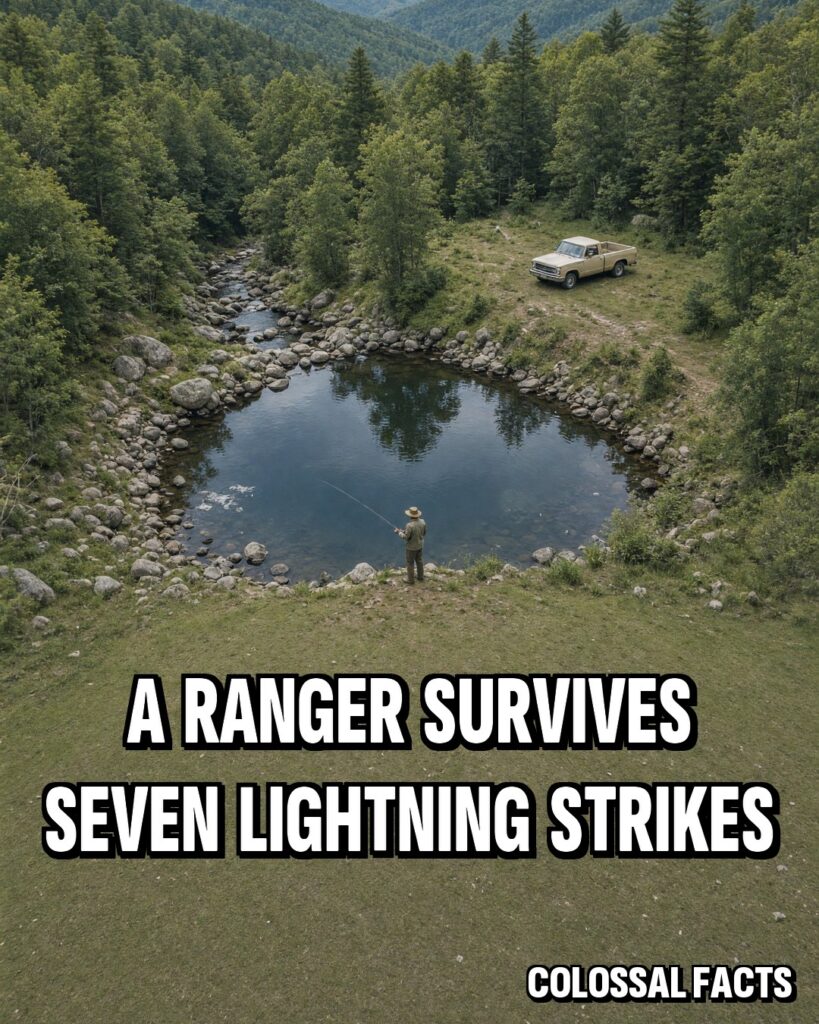
The first time, he hid in a fire lookout tower that had no lightning rod. He said fire was jumping all over the place inside. Another strike caught him driving his pickup on a mountain road. That bolt burned off his eyebrows. After the fourth strike set his hair on fire, fear changed his daily life. He began to believe some force was trying to destroy him. For months, when a storm caught him at the wheel, he pulled over and lay on the front seat until it passed. The last lightning hit him in 1977, while he was fishing. It singed his hair and burned his chest and stomach.
The ordeal did not stop there, in his own telling. Heading for his car, he met a bear that tried to steal his trout. Sullivan struck it with a branch. He said it was the twenty-second time he had hit a bear with a stick. Like many ranger stories, the bear count is his. The seven lightning strikes are the part that park records and Guinness accepted. Lightning left the burns. The bear, he said, did not take the fish without a fight.
Seven strikes, and a death that was not lightning
Sullivan became a reluctant celebrity, “the human lightning rod,” asked again and again to retell the same seven days. He carried a scarred hat and a scarred body, and he kept working in the park for years after the first bolt. Lightning is not supposed to have a favorite person. What it has is a tall target, an exposed ridge, and bad luck repeated. People who work outdoors in thunderstorm country are struck more often than office workers; almost no one is struck seven times and lives to have each event written down.
He was not killed by lightning. He died on 28 September 1983, at the age of 71, by a self-inflicted gunshot. The record he still holds is for survival, not for a last fatal bolt. The lookout tower, the truck, the fishing trip, and the burns are the documented sequence. The myth is that lightning “never strikes twice.” Sullivan’s life was the blunt reply, seven times over, from a ridge in Shenandoah.
Shenandoah’s Skyline Drive and its exposed ridges are a bad office in a thunderstorm, and Sullivan’s job took him into that weather again and again. He once hid from a storm and was still hit; he once ran from a storm and was still hit. After the later strikes he was said to have avoided even standing near a crowd if clouds built up, a fear that sounds comic until the tally is seven. Park service colleagues corroborated enough of the events for a world record to be granted. The burns, the lost eyebrows, the hair on fire, and the fishing trip in 1977 are the skeleton of the file. Everything else — the feeling of being hunted, the bear, the nickname — sits on top of that file as a man’s own account of a life that lightning would not leave alone.
Sources: Most lightning strikes survived – Guinness World Records, Roy Sullivan – Wikipedia, Shenandoah National Park – National Park Service