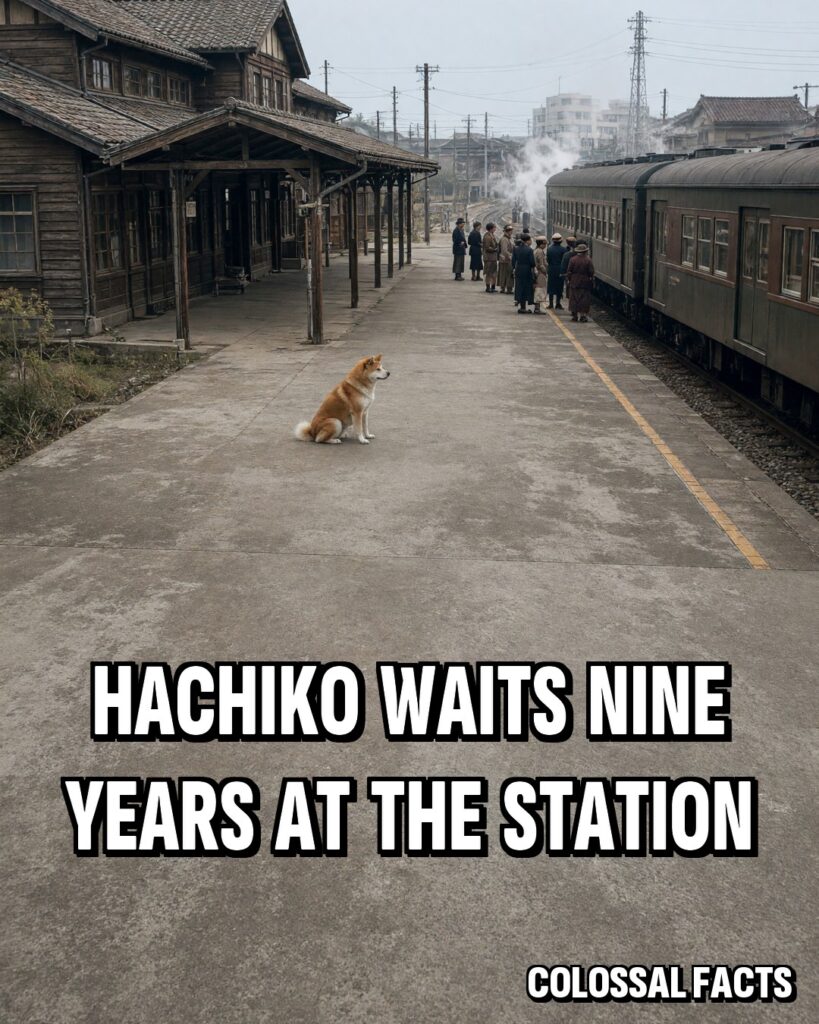
In 1923, in Akita Prefecture, Japan, a dog of the Akita breed was born. His name was Hachiko. Professor Hidesaburō Ueno of Tokyo Imperial University took him as a pet and brought him to live in Shibuya, Tokyo. Every day Hachiko went to Shibuya Station and met his owner when the train pulled in. It looked like an ordinary habit between a man and a dog.
On 21 May 1925, Ueno died suddenly at his workplace from a cerebral hemorrhage. The dog never stopped coming. He returned every day, right when the train was due, and waited for a man who would not step off. He kept that watch for nine years, nine months and 15 days. At first the station staff were not friendly. Hachiko was in their way. On 4 October 1932, the newspaper Asahi Shimbun published an article about him. People started bringing him food and treats while he waited. He was then one of only a small number of documented purebred Akitas — some accounts say about 30 — and he turned into a national symbol of loyalty.
Neither old age nor arthritis broke the habit. In April 1934 a bronze statue of him was unveiled at the station, the work of the sculptor Teru Ando, and Hachiko was there among the crowd. He had lived to see his own monument. On 8 March 1935, Hachiko died, near the station he had refused to give up. His remains were later placed at Aoyama Cemetery, with Ueno. During the Second World War the first statue was melted for metal. In 1948 it was replaced by a new bronze, made by Takeshi Ando, the first sculptor’s son. That statue is still the meeting place at Shibuya, one of the most familiar spots in Tokyo.
A daily wait that outlived the man
The story is simple, which is why it lasted. A professor took a train. A dog learned the timetable. The man died, and the timetable did not. Station workers who had once shooed the dog away later looked after him. Teachers used the tale in classrooms as a lesson in devotion. Films and books followed, in Japan and abroad, but they did not invent the core of it: the dates, the station, and a dog who kept a useless, faithful appointment.
Akita dogs were already a prized Japanese breed. Hachiko’s fame helped fix the image of the Akita as loyal and stubborn, and it tied that image forever to one set of station steps. People still arrange to “meet at Hachiko,” often without thinking of the professor who never came back. The statue faces the scramble crossing, and the trains still arrive on time.
The train still stops
The train still stops at the station. His owner never steps off it again. What remains is a bronze dog, a grave beside a professor, and a habit so ordinary that it became, by lasting nine years after a death, one of the best-known stories a city ever told about a pet.
Hachiko was born on 10 November 1923 and was brought to Tokyo as a puppy. After Ueno’s death, the professor’s former gardener and others helped care for the dog, even as Hachiko kept his own hours at the station. A stuffed Hachiko is preserved at the National Museum of Nature and Science in Ueno, Tokyo, so the animal is not only a statue and a story. Each year, on the anniversary of his death, people still lay flowers at the Shibuya bronze. The meeting spot works because everyone in the city knows which dog you mean, and which exit.
Sources: Hachikō – Wikipedia, A famous dog, immortalized in bronze – NPR, Statue of Hachiko – Japan National Tourism Organization