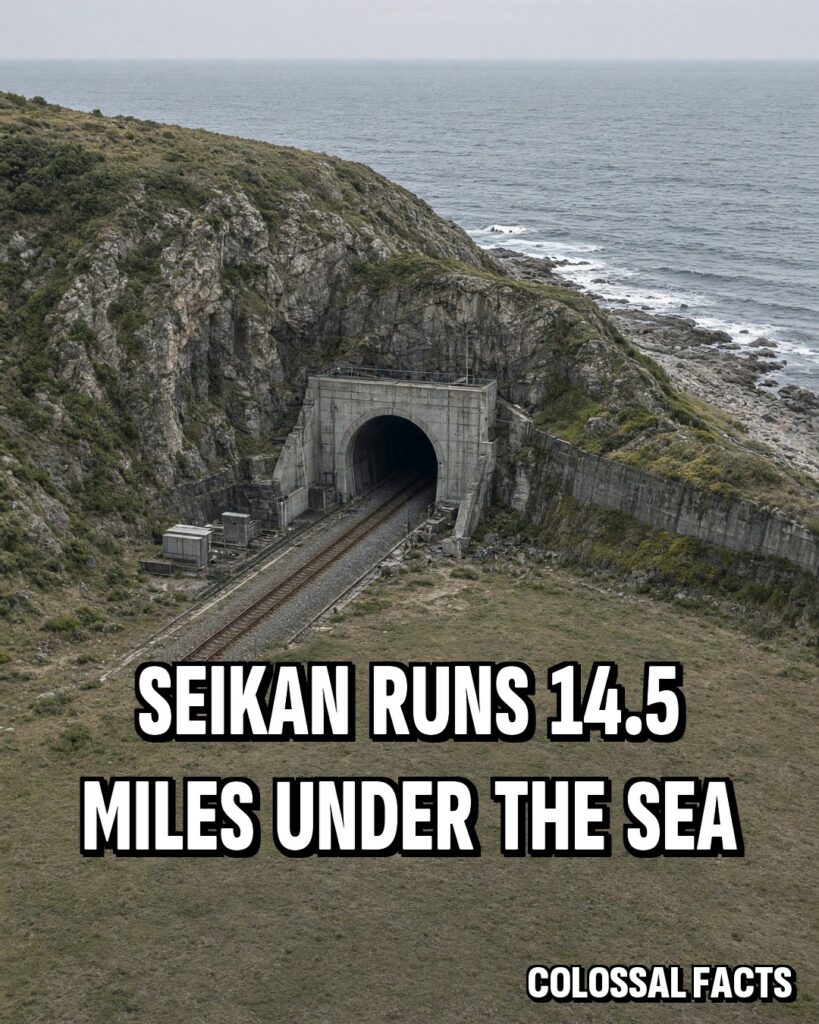
The Seikan Tunnel is a dual-gauge railway tunnel in Japan. It links Aomori Prefecture on Honshu with the island of Hokkaido, under the Tsugaru Strait. Dual gauge means two pairs of rails in one track, so trains with different wheel spacing can use the same route. The Japan Railway Construction, Transport and Technology Agency gives the main tunnel’s length as 53.85 kilometers (33.5 miles). Of that, 23.30 kilometers (14.5 miles) pass beneath the seabed, and the tracks reach 240 meters (787 feet) below sea level at the deepest point. It is the deepest railway tunnel below sea level.
The tunnel is not a single bore. It was built as three tubes: a pilot tunnel, a service tunnel for maintenance, drainage, and ventilation, and the main tunnel for trains. The main tunnel was sized from the start for Shinkansen trainsets, which are wider than Japan’s ordinary trains. That choice mattered decades later, when high-speed trains finally used the same undersea route.
A typhoon that closed the case for a tunnel
Why dig it at all? On 26 September 1954, the ferry Toya Maru sank in a typhoon at Hakodate. Japan’s marine accident inquiry recorded 1,155 deaths on that ship alone. Other Seikan ferries were lost in the same storm, and the combined death toll is often put at more than 1,400. Official histories of the tunnel treat that disaster as the event that pushed plans for a crossing a storm could not shut down. Construction was a long campaign against soft ground, fissures, and high-pressure seawater. Digging killed 34 people in cave-ins, floods, and other accidents. The work lasted about 24 years. The tunnel opened on 13 March 1988 as the Tsugaru Kaikyo Line.
Longer than the Channel Tunnel, but not under the sea for as far
By total length, the Seikan Tunnel is still longer than the Channel Tunnel between Britain and France, and it has long been described as the world’s longest tunnel with an undersea section. Its stretch actually under the sea, though, is shorter than the Channel Tunnel’s undersea run of nearly 38 kilometers. The two records are easy to mix up: one is the full length of a tunnel that goes under the sea; the other is how many miles of it sit beneath the water.
JRTT’s official history records four major inrushes of water during the undersea drive, each of them a threat to flood the works. Crews answered with advance boring, grouting, and shotcrete, methods developed in part on this job. JR Hokkaido’s own figures put the construction period at about 24 years and list huge quantities of cement, steel, and excavated rock. A continuous welded rail more than 52 kilometers long runs through the main tunnel. Even after opening, the undersea section has to be monitored for leakage and high water pressure; the agency that built it still describes the tunnel as a special environment, not an ordinary mountain bore.
On 26 March 2016, the Hokkaido Shinkansen began running through the tunnel, between Shin-Aomori and Shin-Hakodate-Hokuto. The dual-gauge track lets narrow-gauge freight and passenger trains share the route with standard-gauge high-speed trains. Speeds in the undersea section are limited when the two kinds of traffic share the tunnel, a compromise between a freight railway and a high-speed line in the same bore. The tunnel that replaced the ferry now carries both. The strait took the ferry. The tunnel stays beneath it.
Today the tunnel is the fixed link that the 1954 typhoon showed a ferry could not guarantee. Freight still needs the route, and so do passengers who once would have crossed the strait by ship. The engineering is hidden under the seabed, but the purpose is the same as it was when the first heading was driven: a railway that a storm cannot close.
Sources: Hokkaido Shinkansen / Seikan Tunnel pamphlet – JRTT, Seikan Tunnel in figures – JR Hokkaido, Toya Maru disaster – Japan Marine Accident Inquiry Agency