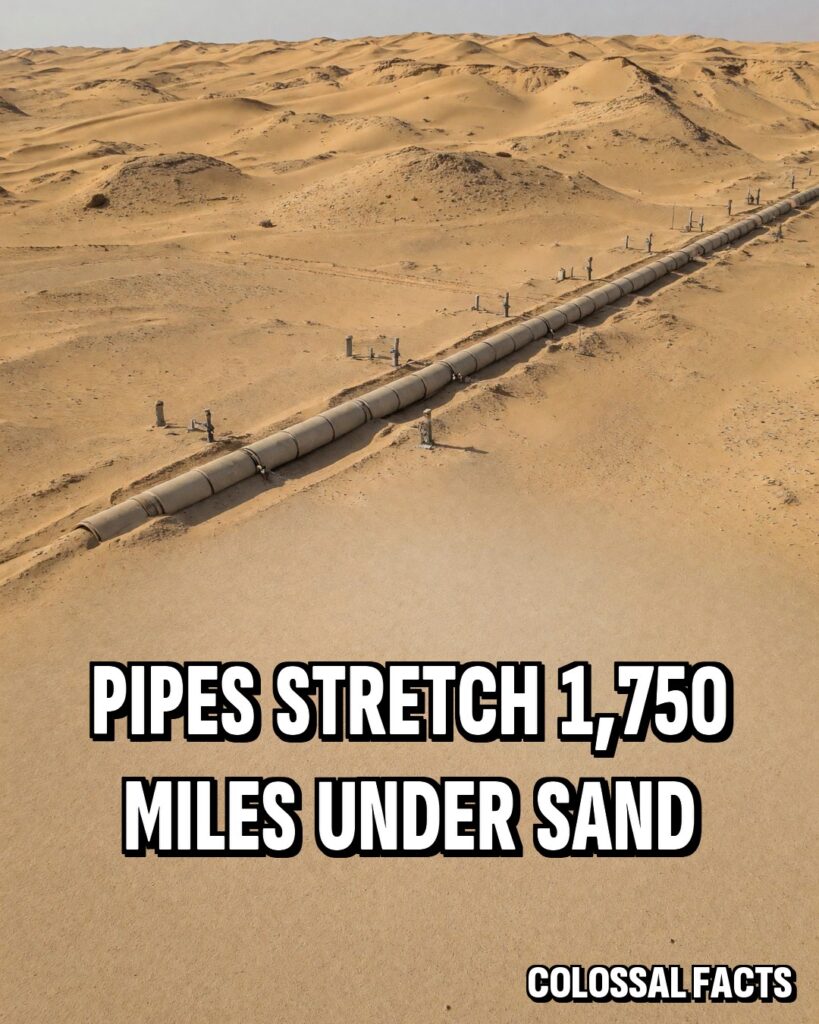
The Great Man-Made River is one of the world's largest irrigation projects. It carries fossil groundwater through an underground network of pipes beneath Libya's desert.
The network stretches about 1,750 miles (2,820 kilometers).
The water was discovered in the 1950s, when oil exploration drilling near Al-Kufrah in southeastern Libya struck a vast underground reservoir.
This is fossil water.
Some of it may be up to a million years old, trapped in sandstone from a time when the Sahara had a much wetter climate.
More than 1,300 wells tap the aquifers. Most are deeper than 1,640 feet (500 meters).
The system was designed to supply cities including Tripoli, Benghazi and Sirte, transporting millions of cubic meters of fresh water each day.
In some places, enormous pipe sections emerge from the sand like submarines breaking the surface.
The water travels as far as 994 miles (1,600 kilometers) and has been reported to provide about 70 percent of Libya's freshwater supply.
Libya's former leader, Muammar Gaddafi, called it the "Eighth Wonder of the World."
The project authority estimated that the raw materials used to make the pipes could have built 20 Great Pyramids of Giza.
Beneath the desert, ancient water moves toward modern cities.
The river has no open channel.
Its path is buried under the sand.
Enjoyed the story?
Follow Colossal Facts for a new story every day.
Or watch them as short videos on Facebook →