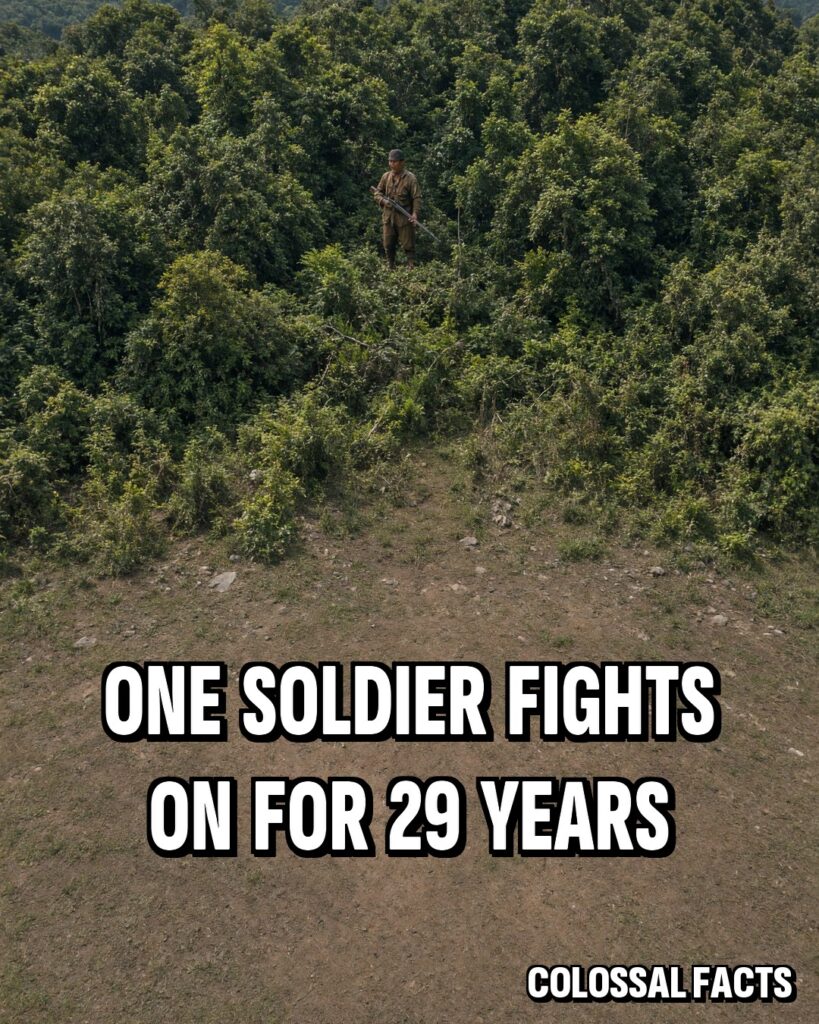
In 1945, Japan surrendered. On Lubang Island in the Philippines, Japanese intelligence officer Hiroo Onoda did not. He kept fighting a guerrilla war, a small hidden campaign against an enemy he believed was still there. His wartime orders, as he understood them, told him not to surrender, to keep collecting intelligence and harassing the other side, and not to take his own life. For him, the end had not come.
Why did he reject the leaflets that were dropped and left for him over the years, including newspapers and family letters? He later said he found mistakes in them and took them for an American trick. In his memoir he admitted that he and comrade Kinshichi Kozuka had clung so hard to their own beliefs that they could no longer understand anything that went against them. Other members of the small group left or died as the decades passed. One surrendered in 1950. Kozuka was killed in 1972. Filipino civilians and police were also killed or wounded in clashes over those years, a part of the story that is easy to leave out of a tale of stubborn endurance and should not be.
An order that only his commander could cancel
Nearly 29 years passed after the surrender. In February 1974 a Japanese traveler, Norio Suzuki, found Onoda and tried to talk him out of the jungle. Onoda refused to give up unless his former commander cancelled the 1944 order in person. In March 1974 Major Yoshimi Taniguchi flew to the island and did exactly that. Only then did Onoda put down his weapon. He saluted and handed over his Type 99 rifle, about 500 remaining rounds, grenades, and a sword. He also turned in his diary and the dagger his mother had given him when he left. Everything was still in working condition.
He returned to Japan a celebrity, later spent years in Brazil, and died in 2014, aged 91. The leaflets could not convince him. A radio announcement of peace could not. His commander’s verbal order could. The war on Lubang ended the day the man who had sent him there told him, face to face, that it was over.
Return, fame, and the years that followed
Japan in 1974 received Onoda as a living relic of a war that had been over for a generation. He was praised for loyalty and also questioned, because the holdout had not been bloodless for the people of Lubang. He gave his rifle to the president of the Philippines and received a pardon for acts committed while he still considered himself at war. In Japan he was uneasy with celebrity and with the spoiled plenty of the postwar boom. He left for a ranch in Brazil, then later ran a nature camp for children in Japan, and lived until 16 January 2014.
Suzuki, the traveler who found him, had been looking for Onoda, a panda, and the abominable snowman — a detail so strange it is often repeated, and it is true to Suzuki’s own account of a private quest. The serious mechanism of the surrender was simpler and more military: only the officer who had given the order could lift it. Onoda had been a trained intelligence holdout, not a man who missed a radio bulletin by accident. That is why leaflets failed and a voice on the jungle path succeeded. Twenty-nine years after 1945, the war ended for him in a salute, with a working rifle and a mother’s dagger still in his kit.
Sources: Hiroo Onoda obituary – The Guardian, Hiroo Onoda, Japanese soldier who hid for 29 years, dies – BBC News, Hiroo Onoda – Wikipedia