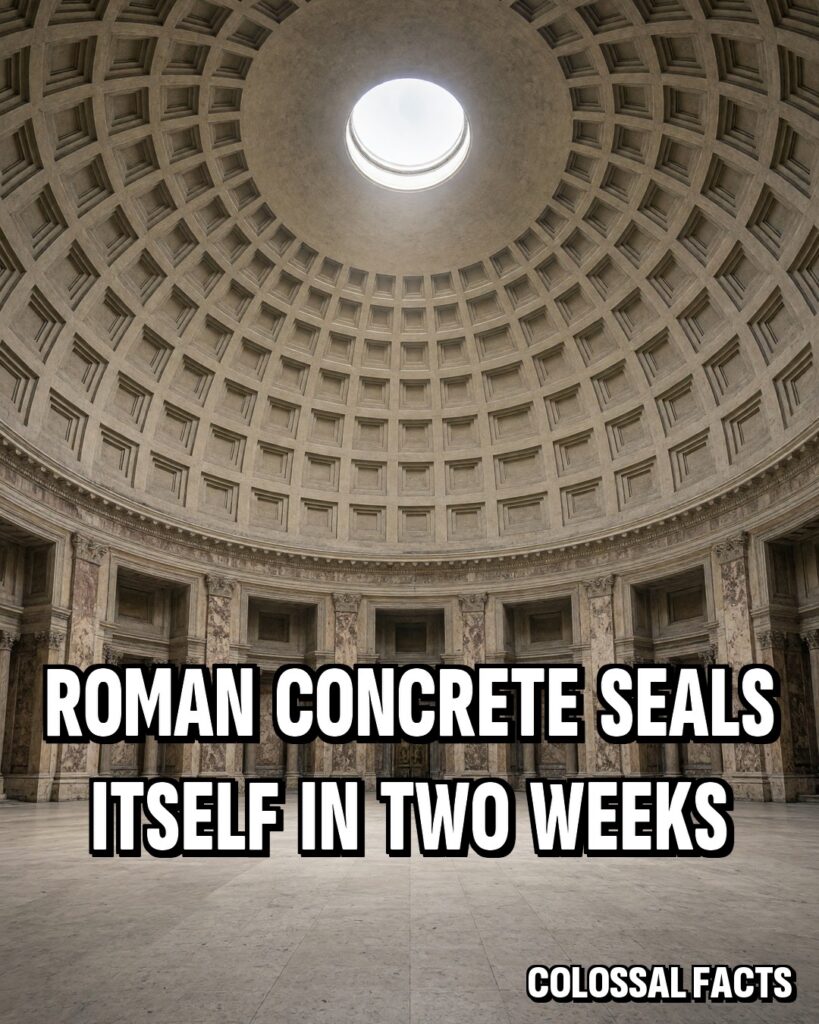
The Pantheon in Rome has the world’s largest unreinforced concrete dome. Dedicated around 128 CE, in the reign of the emperor Hadrian, it still stands intact, with a coffered dome about 43 meters across and a circular opening, the oculus, at the top. The secret of that endurance is not just age. Roman builders mixed lime with volcanic ash, the material often called pozzolana, and — according to a 2023 study led by researchers at MIT and published in Science Advances — they used a highly reactive form of lime, quicklime, in a hot-mixing process. White lumps, or lime clasts, remained in the mix. Those leftover pieces of lime stay chemically reactive.
What does water do when it later finds a crack? It enters the split, dissolves the lime clasts, and triggers reactions that produce calcium carbonate and other minerals to fill the opening before it can spread. In the laboratory, cracks in samples of this kind of mix closed completely within two weeks, and the water stopped. The same sample mixed without the quicklime never healed, and the water kept flowing. The reactions start on their own, so the concrete can heal before a crack threatens the structure.
A method you can still see in the ruins
A construction site in Pompeii, buried by the eruption of Mount Vesuvius in 79 CE, has provided archaeological evidence of the same hot-mixing method, with lime clasts visible in the walls. Admir Masic, an associate professor at MIT and a co-author of the study, has described Roman concrete as durable, self-healing, and dynamic. That is a scientific claim about the chemistry, not a promise that every Roman wall is immortal. But the record of the material is hard to argue with. Roman concrete has survived earthquakes, volcanic eruptions, and years under the sea, in harbors where seawater actually seems to have strengthened some of the piers.
Modern Portland cement concrete is different. It is usually a cooler mix, it often needs steel reinforcement, and it does not routinely close its own cracks in two weeks. The Pantheon dome still stands with no steel in it. The 2023 paper does not say the Romans invented a miracle for every job. It says that a 2,000-year-old way of mixing lime left reactive lumps in the concrete, and that those lumps can seal a crack when water arrives. The dome is the exhibit. The cracks, in the lab at least, close on their own.
Why the Pantheon is the proof, not the lab
The 2023 paper did not analyze the Pantheon dome itself as its only sample. It studied Roman concrete and compared mixes, including material and methods that match what can be seen in Roman walls and in Pompeii. The Pantheon is the public proof that an unreinforced concrete dome of that span can last 1,900 years in a city of earthquakes and weather. Hadrian’s building reused a site with earlier temples; the present rotunda and dome are the ones that endure. Gravity, and the stepped thinning of the dome toward the oculus, are part of the structural story. The chemistry of the lime is the part that had been underestimated.
For a long time, many textbooks treated the volcanic ash as the main Roman trick and the white lumps as sloppy leftover lime. The MIT-led team argued the opposite: the lumps were a feature of a hot mix, and they are what let later cracks close. Two weeks in a laboratory is not two thousand years in the Forum. It is, however, a clear difference between a mix that heals and a mix that does not. A method from the first and second centuries still has a dome standing with no steel in it, and a self-sealing reaction that modern builders are now studying in earnest.
Sources: Hot mixing and self-healing in Roman concrete – Science Advances, Riddle of Roman concrete solved – MIT News, Pantheon, Rome – Wikipedia