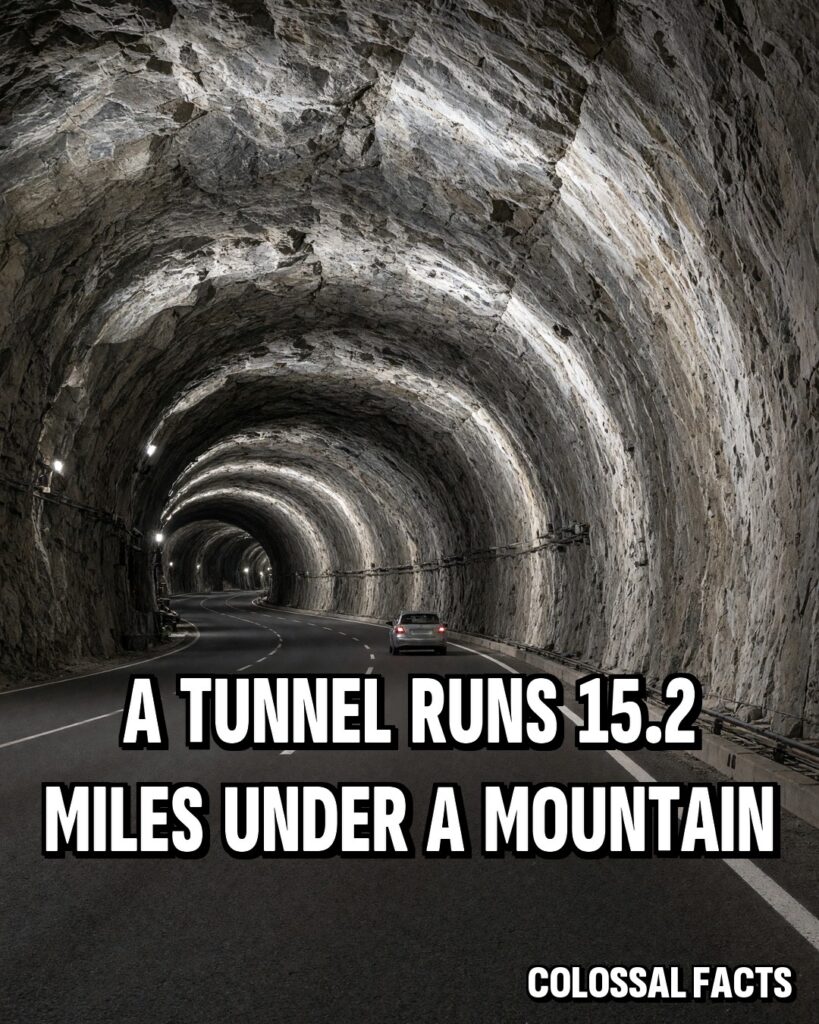
Lærdal in Norway has the world’s longest road tunnel. It runs 24,509 metres — 24.5 kilometres, or 15.2 miles — through the mountains between Aurland and Lærdal in Vestland county. That exact length is the figure published by the Norwegian Public Roads Administration, Statens vegvesen. Guinness World Records lists it as the longest road tunnel on Earth.
Construction ran from 1995 to 2000. King Harald officially opened the tunnel on 27 November 2000. The new link completed the main road between Oslo and Bergen — European route E16 — so cars and trucks can travel between the two cities without taking ferries or making difficult mountain crossings in winter. The tunnel is part of the European TEN-T road network. It has two lanes, one in each direction, and there is no toll.
A long drive needs a break in the dark
Boring through the rock is only half the job. Someone still has to sit behind the wheel. A drive of more than 15 miles underground strains the mind: the walls do not change, daylight disappears, and fatigue sets in more easily than on an open road. So the design does more than carry cars. It breaks the sameness of the corridor.
The route is split into four sections by three huge, lit caverns cut into the mountain. They sit about six kilometres (3.7 miles) apart and include space to park or turn around. The halls are lit with blue above and yellow below, a scheme meant to suggest daylight or a sunrise over ice and rock. The aim is to ease monotony and to reduce the chance that a driver becomes drowsy in the middle of the run. The lighting and the shape of the caverns drew on work by designers and artists, not only on standard tunnel engineering.
At a steady 80 km/h — about 50 mph, a typical limit for a road of this kind — a driver still spends well over a quarter of an hour in the mountain. That is why the three halls matter as much as the raw length. They turn one extreme corridor into four shorter stages. The whole run is as long as hundreds of American football fields laid end to end. Longer rail tunnels exist, but for cars and trucks this 15.2-mile bore is still the mark to beat.
Safety, traffic and the upgrade now under way
A tunnel of this length cannot rely on frequent exits to the open air. It uses lay-bys, turning bays, emergency telephones, fire equipment, ventilation and lighting designed for a long enclosed road. Statens vegvesen reports average daily traffic of about 2,100 vehicles, with a heavy-vehicle share of 26 percent.
An upgrade to meet current tunnel-safety rules is no longer only a plan. Official project pages say the work started on 16 November 2026. The tunnel is closed at night, from 18:00 to 06:00, while blasting and installation go on; buses and emergency vehicles keep limited access, and daytime traffic continues with shorter delays. The project includes 28 new technical buildings, more lay-bys and turning bays, emergency cabinets every 250 metres, new lighting, ventilation, cameras and communications. Official pages give a completion window into 2029–2031. The record length does not change. The safety systems inside it do.
A winter road without the ferry
Before the tunnel opened, the mountain crossing between these valleys could be slow or closed in winter, and the alternative involved ferries on the fjords. The E16 link was meant to give western and eastern Norway a reliable all-year road. That is why a record-length tunnel was built here, rather than as a showpiece on a quiet local road. The record is the span of rock that had to be opened to make the journey ordinary.
More than a quarter of a century after the opening, Lærdal remains the longest road tunnel in the world. The number to quote is 24,509 metres — 15.2 miles of rock, broken into four stages by three lit halls, now being brought up to today’s safety rules while the traffic still goes through.
Why the record was cut here
Oslo and Bergen are not close, and the mountains between them are not a casual crossing in January. Before November 2000, the choice on this stretch was a winter mountain road that could close, or a longer route with ferries on the fjords. The E16 needed a hole through the rock so that the main road could stay open all year. That practical need, not a desire for a record, is why the world’s longest road tunnel is here, in Vestland, between Aurland and Lærdal, and why it was worth building 24,509 metres of two-lane road with no toll.
The three halls are the human half of the same decision. A driver who must spend a quarter of an hour or more underground needs a change in the light and a place to stop or turn. The blue-and-yellow caverns, about six kilometres apart, do that job. The upgrade that began on 16 November 2026 does the other half: bringing a tunnel opened in 2000 up to today’s fire, ventilation and communication rules, while the 2,100 or so vehicles that use it each day still have to get through. Night closures and daytime narrowing are the price of keeping the record in service. The length will still be 24,509 metres when the work is done. What changes is how safely a driver can spend those 15.2 miles in the mountain.
Sources
- Statens vegvesen – E16 Lærdal Tunnel (24,509 m; about 2,100 vehicles a day, 26% heavy traffic; upgrade from 16 November 2026)
- Guinness World Records – Longest road tunnel