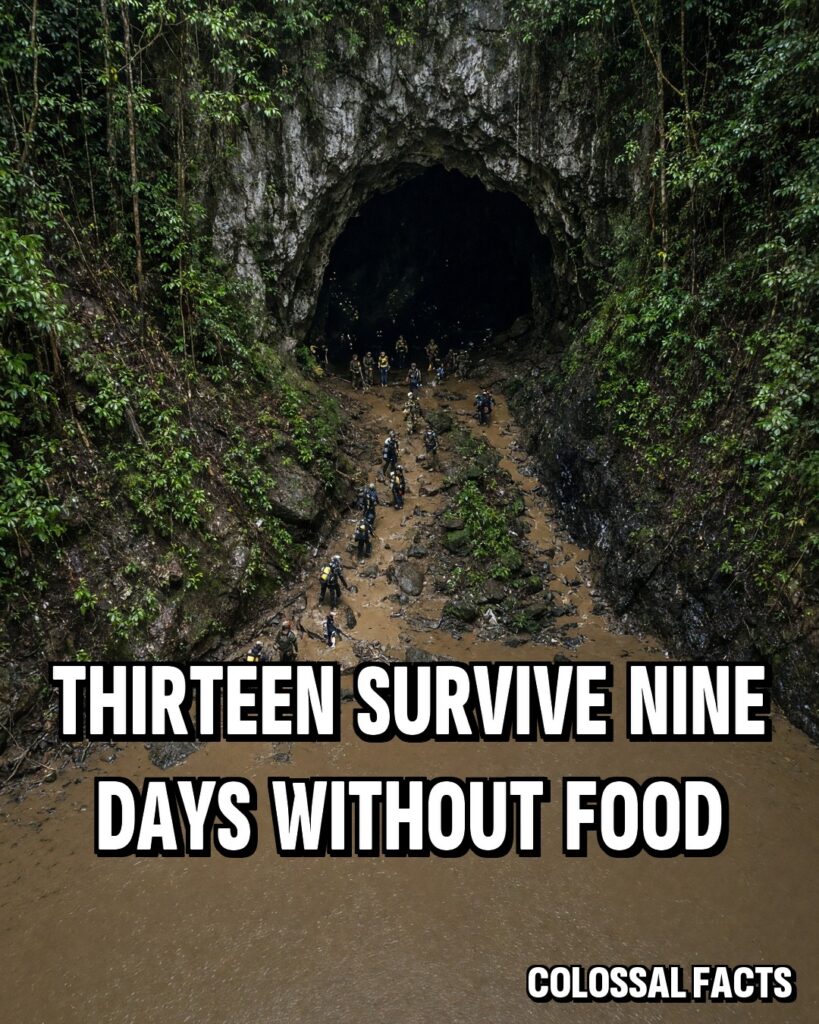
On 23 June 2018, the Wild Boars soccer team walked into Tham Luang Nang Non cave, in Chiang Rai province in northern Thailand, after practice. Twelve boys, aged about 11 to 16, went in with their 25-year-old assistant coach, Ekkapol Chantawong. Monsoon rains, the heavy seasonal storms, flooded the cave behind them. The boys and their coach were stuck on a muddy ledge about 1.2 miles (2 kilometers) from the entrance, past narrow, flooded passages. The food ran out. So did the light. They lasted nine days by sipping water that had condensed on the walls.
On 2 July, British cave divers John Volanthen and Rick Stanton pushed through those passages and found them alive. “How many of you?” Volanthen asked. “Thirteen,” one of the boys answered. “Brilliant,” Volanthen said. The search had already become an international effort: Thai Navy SEALs, police, soldiers, and cave divers from Britain and other countries. Up to 10,000 people joined the operation, including support crews who pumped water, hauled gear, and kept the entrance works running in the rain.
Being found was not the same as being out. The way back was long, dark, and full of water, too hard for weak, untrained boys to dive on their own. The coach chose the leaving order and wrote it down in numbers. Divers from several countries then sedated them, putting them to sleep under the care of an Australian anaesthetist, Richard Harris, and his partner Craig Challen, and took them through the flooded tunnels. They carried them, pulled them, and in places swam with them, each boy in a face mask, on a stretcher or in a diver’s hold, through sumps that had already killed hope once.
A rescue that took three days, and one that did not come back
The extractions ran from 8 to 10 July. All 13 came out alive. On 6 July, before those final dives, a former combat swimmer from the Royal Thai Navy special forces, Saman Gunan, who had come as a volunteer, suffocated on the way back after delivering air tanks to the group. He was the operation’s first death. Another Thai Navy SEAL, Beirut Pakbara, later died of a blood infection related to the mission. The rescuers later said they had not been sure, going in, why the plan would work. But it had. The monsoon was still rising. A few more days of rain might have closed the route again.
The story went around the world as a cave miracle. On the ground it was a sequence of ugly, practical jobs: pumping, mapping, laying lines, and then a medical plan that looked almost brutal — sleep, a tight mask, a long pull through the dark — because the alternative was to wait for a flood that would not recede in time. The boys later recovered in hospital in Chiang Rai. The cave was later restricted, and the names of the two men who died were added to the public memory of the rescue.
Thirteen out, and the man who brought the air
Thirteen people came out alive. One man brought the air and did not return. The nine days without contact are the part the title remembers. The harder part came after the light of the divers’ lamps: a flooded tunnel, a sedated child, and a line of people who had to get all 13 home before the water rose again.
Chiang Rai hospital later showed the boys to the cameras, thin but walking. Several of the divers, including Stanton, Volanthen, Harris, and Challen, were honoured in Britain and in Thailand. The cave itself, a place local boys had entered before in dry weeks, became a symbol of how fast a monsoon can close a door. The operation is now studied as a case in which a wild, flooded cave was turned, for a few days, into a managed underwater corridor. It only stayed that way for as long as the pumps and the weather allowed.
Sources: Thailand cave rescue – BBC, Tham Luang cave rescue – Wikipedia, All 12 boys and coach freed – The Guardian