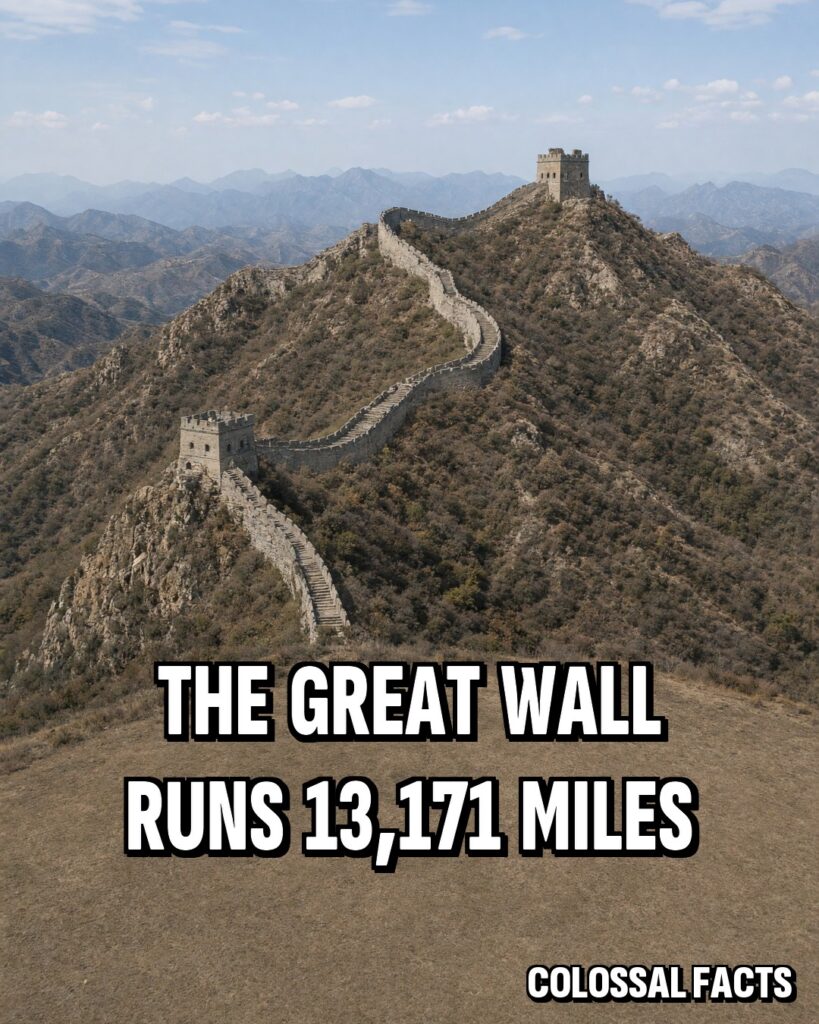
The Great Wall of China is the largest defensive work people have ever built. It runs 13,170.7 miles (21,196.18 kilometers). Maps make it look like one unbroken line through the mountains. It is not. The total counts walls, trenches, and natural barriers from different dynasties. It also counts sections rebuilt on top of older ones.
A trench is a canal or ditch dug as part of the defense. A natural barrier is a mountain or steep slope that stopped an army by itself and was written into the line. These parts cross 15 provinces, autonomous regions, and municipalities. The number comes from the first comprehensive scientific survey of every section. China’s State Administration of Cultural Heritage and the State Bureau of Surveying and Mapping released it in June 2012. The work took about six years, beginning in 2007, and used mapping, field inspection, and earlier records.
Earlier popular figures stuck to the best-preserved Ming dynasty stretch. A previous official survey, released in 2009, put the Ming wall at about 5,500 miles (8,851.8 kilometers). That Ming line, much of it stone and brick, is the wall most visitors walk at Badaling or Mutianyu, near Beijing. It was inscribed as a UNESCO World Heritage Site in 1987. The 2012 total is far longer because it folds in earlier walls from the Warring States period, the Qin unification, the Han, and later dynasties, including earthworks that have worn down to ridges in the land.
Not one wall, and not a line you can see from the Moon
Building started more than 2,200 years ago. In 221 BCE, after Qin Shi Huang unified China, older state walls were joined and extended as a northern defense. Later dynasties repaired, abandoned, and rebuilt long stretches as the frontier moved. Watchtowers, beacon platforms, and garrison forts sat on the line. Soldiers who manned them lived with wind, supply shortages, and long gaps between more solid sections.
The wall is not a single ribbon that a traveler could once walk without a break. Large parts have eroded, been quarried for stone, or never were more than tamped earth. The popular claim that it is visible from the Moon, or easily seen from space with the naked eye, does not hold up. Astronauts have said that it is hard to pick out from low orbit without aid, and it is not visible from the Moon at all. The work is vast on the ground. It does not need a myth to be impressive.
Two official lengths, two different questions
The full length is longer than half the way around Earth at the equator, which is about 24,901 miles (40,075 kilometers). That comparison is a way to feel the survey number, not a claim that a single battlement runs halfway around the world. The old figure covers one dynasty. The new one measures centuries of building. On a steep slope, the mountain was the defense, and it is part of the total.
This is not only stone on a ridge. It is a long ledger of walls, ditches, and hills, added up after six years of measurement, and it is still being worn away by weather, roads, and time.
Western stretches were often tamped earth, not dressed stone, and many of those banks have slumped into the loess and the desert. The poetic Chinese name, a “wall of ten thousand li,” was never a surveyor’s figure. The 2009 and 2012 announcements were an attempt to replace poetry with measurement. Tourists who walk the restored Ming brickwork near Beijing see one dynasty’s best-kept face. The survey added the older, worn, and rebuilt pieces that do not photograph as well, and the mountains that were left to do the work of a wall. That is why the official length jumped, and why the new number is a catalogue, not a single walkable path.
Sources: China’s Great Wall is ‘longer than previously thought’ – BBC, China’s Great Wall is 21,196 km long: survey – China.org.cn, The Great Wall – UNESCO World Heritage