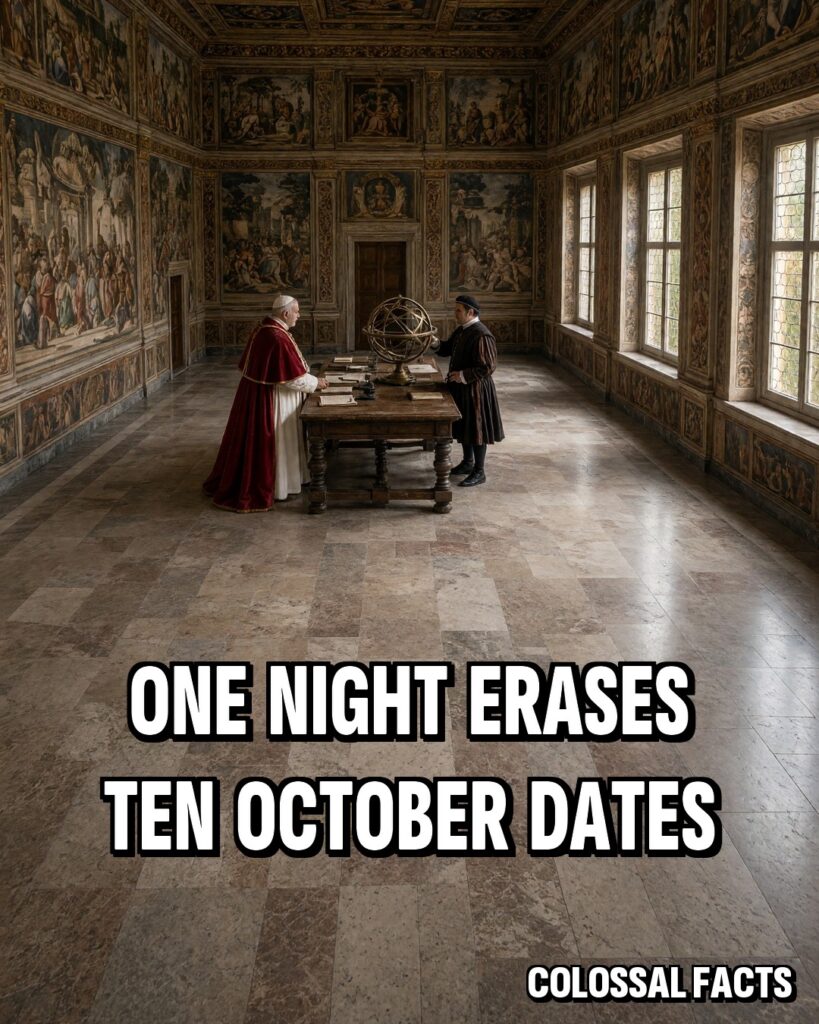
In 1582, Rome and Madrid did something that sounds like a printing error. People went to bed on Thursday, 4 October, and woke on Friday, 15 October. The sun rose on time. They slept their usual hours. Nobody aged ten days in one night.
Why were the dates gone? The Julian year, set in the time of Julius Caesar, ran a little long. It counted 365.25 days, but the tropical year is closer to 365.2422 days. By the late sixteenth century the extra minutes had added up to about ten days. The spring equinox had drifted from 21 March to about 11 March, and the rules for Easter no longer sat in the right part of the season.
Pope Gregory XIII issued the bull Inter gravissimas on 24 February 1582. Luigi Lilio, a Calabrian physician and astronomer, built the foundations of the reform. Christopher Clavius, a Jesuit mathematician, developed them further and defended the new tables. In Catholic lands the next day simply wore a new date. Ten calendar dates were missing. The week continued normally, from Thursday to Friday. A worker who was paid by the day did not lose ten days of labor. A contract tied to a calendar date jumped forward.
A reform that spread at uneven speed
Austria, Spain, Portugal, Italy, Poland, and Catholic Germany suddenly ran ten days ahead of much of the rest of the continent. Protestants and the Orthodox Church refused an order from the pope. They kept the old calendar for a long time. Crossing a border often meant moving forward or backward through the dates. Letters and fairs had to name which calendar they used.
The new leap-year rule was the long-term fix. A century year would be a leap year only if it could be divided by 400. So 1600 and 2000 were leap years; 1700, 1800, and 1900 were not. That change keeps the average Gregorian year at 365.2425 days, close enough that the remaining error is about one day in a few thousand years.
Britain skips eleven days, later
Britain and its American colonies did not switch until 1752. By then the gap had grown to eleven days. Wednesday, 2 September 1752, was followed by Thursday, 14 September. Russia kept the Julian calendar until 1918, which is why the October Revolution of 1917 took place in November on the Western calendar. Some Orthodox churches still use Julian dates for liturgy.
Life did not lose a single hour. The calendar lost only paper. The sky did not jump. Only the names of the days on the wall did, and they did it so that spring, and Easter, would stay where the reformers meant them to be.
Other states moved in their own years. France, along with the papal lands and Spain, adopted the new dates in 1582. Sweden, after a messy partial reform, completed the switch in 1753. Greece changed its civil calendar in 1923. In the British Atlantic world of 1752, some dates still need a double label: George Washington was born on 11 February 1731 on the Julian calendar then in use in Virginia, and on 22 February 1732 if the year and the eleven skipped days are written the modern way. The reform never tried to change the seven-day week. Thursday still gave way to Friday. Only the number painted on the calendar, and the feast days tied to the equinox, were made to catch up with the Sun. After 1582, Europe lived for a long time on two clocks at once, and travelers had to know which one a city was using.
Sources: Gregorian calendar – Encyclopaedia Britannica, The Gregorian Calendar Switch – Time and Date, Adoption of the Gregorian calendar – Wikipedia