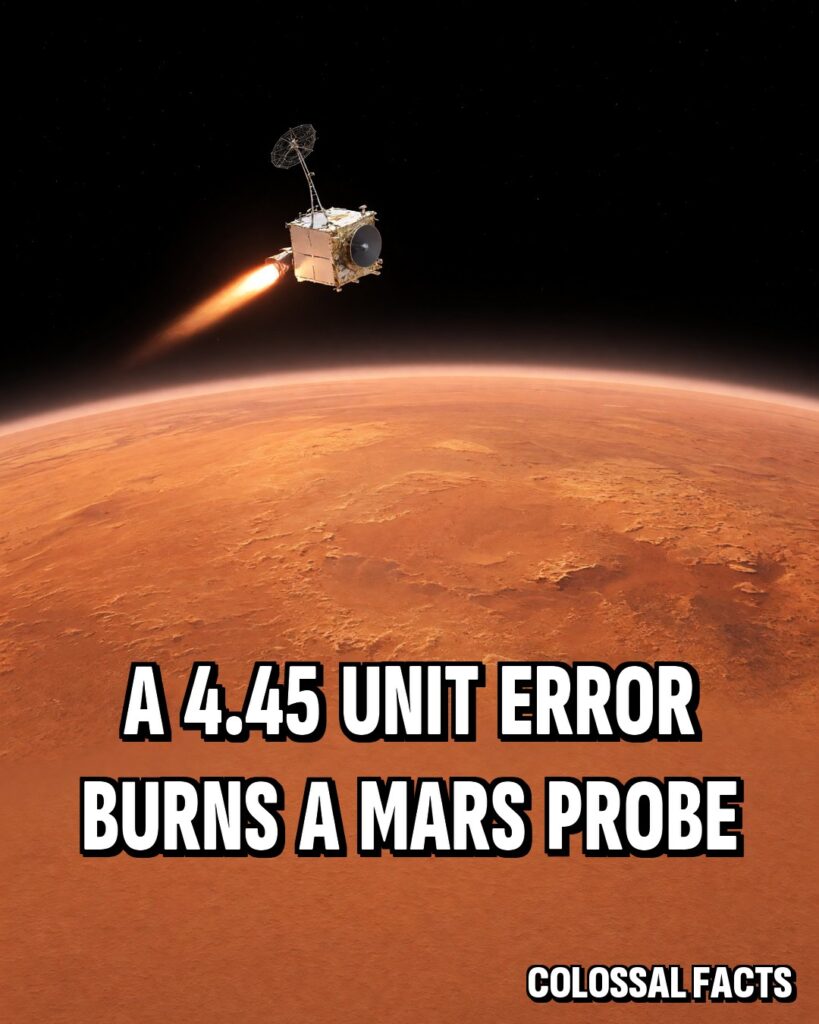
On 11 December 1998, NASA launched Mars Climate Orbiter, a robotic probe meant to circle Mars and study its weather and atmosphere. It was part of the Mars Surveyor ’98 program, built by Lockheed Martin and guided by NASA’s Jet Propulsion Laboratory. The probe flew toward Mars, and from the outside everything looked fine. On 23 September 1999, the time came to slip into orbit. Contact was lost.
Where did it go wrong? One team on Earth worked out the push from thruster firings in pound-force seconds. That is the English unit for impulse, the total shove of each burn. NASA navigation software read the same figures as newton-seconds, the metric unit for the same shove. One pound of force is about 4.45 newtons. Every course correction entered the math wrong. Over the whole flight the error stacked up. The contract and the software interface had required data in newton-seconds. Nobody caught that the “small forces” file was coming in as pound-force seconds.
The probe swung past only about 37 miles (60 kilometers) above the surface of Mars, far below the planned approach of more than 200 kilometers. Below about 53 miles (85 kilometers), simulations showed that friction with the thin air would tear the fragile shell apart. The planned orbit stayed out of reach. The craft burned in the atmosphere of Mars.
A failure written in units
NASA’s Mishap Investigation Board laid the cause out in public. It was not a mysterious fault in space. It was a missed conversion on the ground, plus a series of reviews that did not compare the units in the data with the units the navigator’s software expected. The loss became a textbook example in engineering programs: the math can be careful, and one confused unit is still enough to destroy a spacecraft. The sister craft in the program, Mars Polar Lander, failed later that year on arrival. Together the two losses hit NASA’s “faster, better, cheaper” approach of the 1990s hard.
The cost of the orbiter itself was on the order of $125 million, and the broader ’98 program cost more. The exact budget line matters less than the cheapness of the mistake. A factor of 4.45, applied again and again to tiny thruster pulses, added up to tens of kilometers of missing altitude — the difference between an orbit and a fireball.
The review that did not ask one question
Everyone wonders how the review missed the mistake. The Board’s answer was uncomfortable and useful: different teams spoke in different units, the file that passed between them was not clearly labeled in daily use, and no end-to-end test forced the numbers to declare themselves. You can reach Mars with careful math. One confused unit is enough to burn.
The intended first pass at Mars was supposed to be well above the dangerous part of the atmosphere, on the order of 150 miles (about 226 kilometers). The actual pass, near 60 kilometers, left no margin. Navigation at JPL had been working with a stream of numbers that looked normal and were, in fact, consistently scaled by about 4.45. A ground software file often referred to in the investigation, which reported the effect of small thruster firings, was the weak link. No one had forced that file and the navigation software to state their units in the same language and then proved that they matched. After the loss, NASA tightened reviews on units and interfaces. The probe did not fail because Mars was unknown. It failed because two teams on Earth did not mean the same thing by the same number.
Sources: Mars Climate Orbiter – Wikipedia, Why the Mars Probe Went Off Course – IEEE Spectrum, Mars Climate Orbiter Mishap Investigation Board Report – NASA