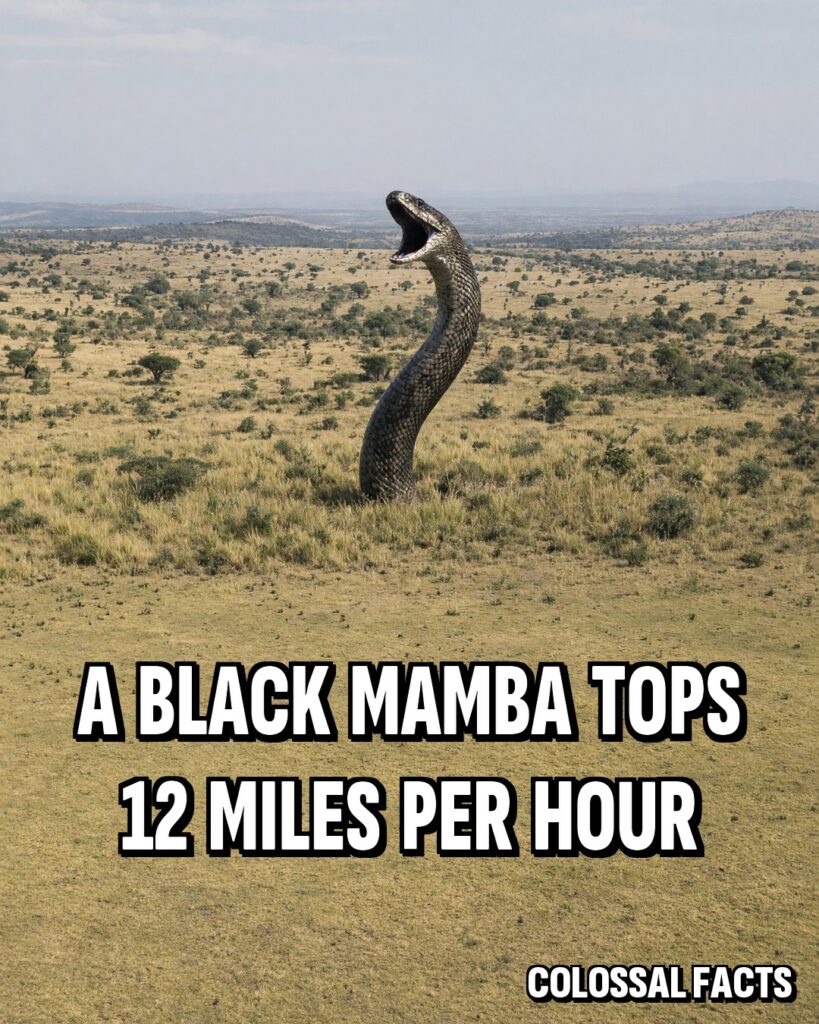
The black mamba (Dendroaspis polylepis) lives in savanna and rocky country in sub-Saharan Africa, chiefly in the east and south of the continent. It is widely regarded as the fastest snake on land. In a short sprint, sources often put its speed around 12 miles per hour (19 km/h); some accounts go as high as about 12.5 mph (20 km/h). Those figures are for a brief burst, not a pace it holds all day.
It has a reputation as one of Africa’s most dangerous snakes. Its usual behavior, though, is shy. If it has a way out, it uses that speed to escape a threat, not to hunt people.
How fast it really is
Exact sprint measurements are hard to make, so encyclopedias and field guides give estimates for a short burst. The range of about 16–20 km/h covers most careful descriptions. Even the upper end is far slower than a cheetah, which can exceed 100 km/h in a sprint — roughly five or six times as fast. On land, though, no other snake is usually credited with a higher speed.
The speed is a defense. The mamba is not chasing prey at 12 mph across open ground as in a film. When it feels threatened, its first choice is to reach shelter: a termite mound, a rock crevice, a hollow, or thick cover.
Its range is mainly eastern and southern Africa, from Kenya and Tanzania to countries such as Zimbabwe, Botswana, Namibia and South Africa, following open and semi-open habitat rather than dense rainforest. The snake is mostly active by day. It lives chiefly on the ground, but it can climb when shelter or prey requires it. It feeds on small mammals and birds.
The name is not the skin
The black in the name is not the color of the body. The skin is gray, olive, khaki, or dark brown, sometimes almost uniform, sometimes lightly mottled. What is black is the inside of the mouth, which shows clearly in a defensive display. Green mambas have a light mouth, and that contrast helps with identification.
Adults are typically about 6.5–8 feet (2–2.5 meters) long. The largest are described at about 14 feet (4.3 meters), which also makes it Africa’s longest venomous snake. The body is slender, and the head has a long, coffin-shaped profile.
Escape first, then a warning
If it is cornered and cannot leave, the behavior changes. It raises the front of its body, sometimes with about a third of its length off the ground, flattens the neck slightly, opens the mouth to show the black interior, and hisses. It may strike more than once. That is the defense of an animal with no exit, not a hunt for people.
Most bites happen when someone startles the snake at close range, steps near its shelter, or tries to kill or catch it. With the forepart raised, the striking reach is longer than that of a snake lying low, which is why hemming it in is dangerous.
The venom
The venom is highly toxic and acts mainly on the nervous system; effects on breathing and the heart are also described. The popular claim that “two drops can kill most people” is hard to treat as a precise medical measure, and we do not repeat it here as fact. What is well established is simpler: an untreated bite can be fatal, and timely antivenom and hospital care sharply improve the odds.
In the regions where the species lives, hospitals that stock the right antivenom and can support breathing are decisive. The venom can act quickly, so delay is dangerous, and home remedies are no substitute for medical care.
The black mamba remains striking for the combination of size, toxic venom, and a short sprint that, on the usual estimates, no other land snake beats. Its record, though, is the escape. The fear so often attached to it begins mainly when that escape is cut off.
Sources: Mamba – Encyclopaedia Britannica, Black mamba – Wikipedia, Black mamba – National Geographic