Bagger 293 is the world’s largest and heaviest land vehicle. TAKRAF built this bucket-wheel excavator in 1995. It is a machine with a spinning wheel of scoops, made to strip away the overburden that sits on top of lignite. It works in the Hambach mine in North Rhine-Westphalia, Germany, a vast open pit run by RWE. Its earlier name was RB293, from the previous owner, Rheinbraun.
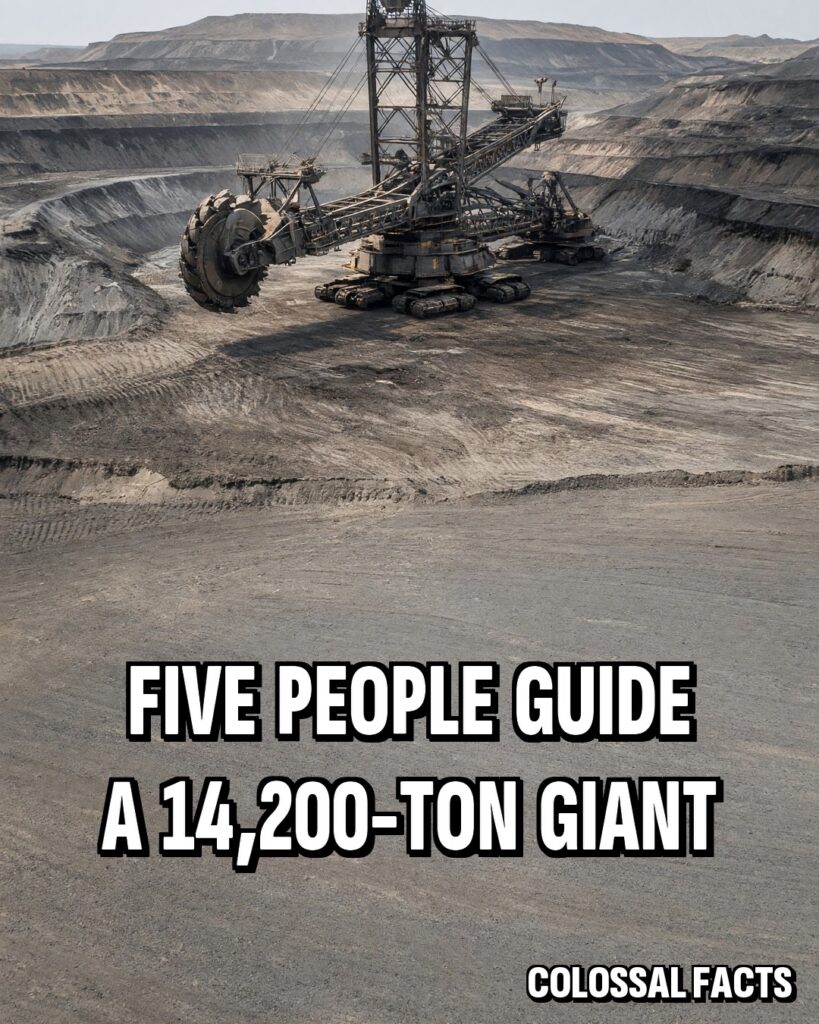
It stands 315 feet (96 meters) tall. Guinness World Records lists Bagger 293 at 310 feet (94.5 meters) and about 14,196 tonnes, while other technical descriptions give 315 feet (96 meters) and about 14,200 tonnes. It shares the tallest-land-vehicle record with the similar Bagger 288. The machine is more than 720 feet (220 meters) long. Five people operate it.
It crawls on 12 tracks at about 2 to 10 meters a minute, or up to about 33 feet a minute. Its tracks leave marks no deeper than those made by a person walking through mud. The enormous weight is spread across those 12 crawlers, so the ground pressure stays surprisingly low for a vehicle that weighs as much as a small ship.
A wheel the height of a four-story building
The cutting tool is a wheel about 21.6 meters (71 feet) across, as tall as a four-story building. Eighteen buckets sit on the rim. Each bucket, in the official Guinness description, holds 6,600 liters. As the wheel turns, the scoops bite into the earth and empty onto a conveyor. The spoil then rides along the body of the machine and off toward the rest of the mine’s belt system. The wheel can cut a face tens of meters high in a single pass.
It can move up to 8.475 million cubic feet (240,000 cubic meters) of earth a day. That is about 96 Olympic-sized swimming pools in one day. The machine does not carry a power plant large enough for that work. Power comes from the external electric grid, at a rate of many megawatts, through trailing cables. Without the cable, the giant does not move.
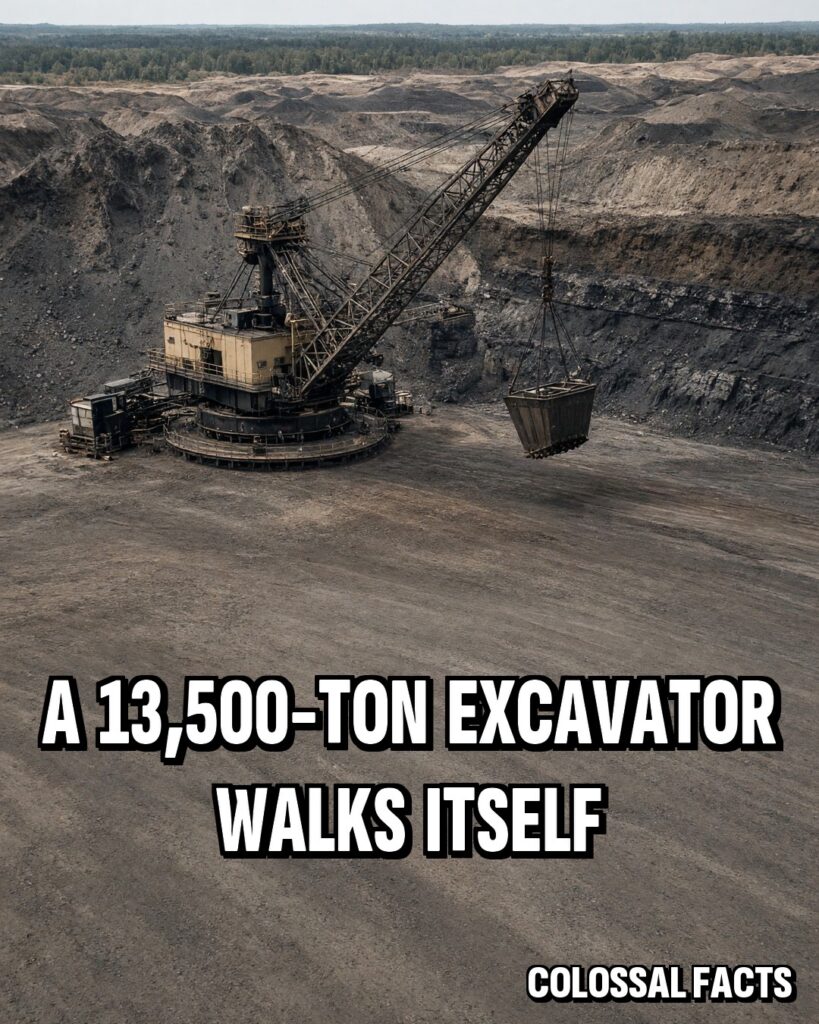
Bagger 293 belongs to a family of TAKRAF bucket-wheel excavators of similar scale, including Bagger 288. They exist for one job: to keep a lignite mine advancing through soft overburden at a pace no truck fleet can match. They are too large to travel on public roads. When a mine face moves, the excavator walks there itself, slowly, on its own tracks.
A hill that answers to five people
From the side it looks like a hill on tracks. Up close it is a moving factory: a wheel, a spine of conveyors, and a control cabin in which a small crew keeps the cut straight and the belts clear. Lignite from Hambach has long fed power stations in the Rhineland. As Germany reduces coal use, the mine’s remaining life is a matter of energy and climate policy, not only of engineering. When the mine closes, no detailed public dismantling plan for this particular machine has been issued.
Until then, all of that mass answers to five people. The wheel turns, the tracks creep forward, and a machine heavier than almost anything else on land peels another slice off the earth.
The bucket wheel can work a face about 51 meters high and cut about 17 meters below its working level, so one pass strips a tall bank of overburden. Its top speed is only about 0.1 to 0.6 kilometers an hour. That crawl is a design choice. A machine this large is assembled at the mine and is not meant to travel on a public road. Hambach is one of Europe’s largest open-pit lignite mines, and machines in this TAKRAF class exist to keep the face moving at the pace of a power station’s appetite for brown coal. When the belts are running, five people in the cab are not joyriding a record vehicle. They are keeping a moving factory on cut, on grade, and on the cable that feeds it.
Sources: Heaviest land vehicle – Guinness World Records, Largest land vehicle – Guinness World Records, Bagger 293 – Wikipedia