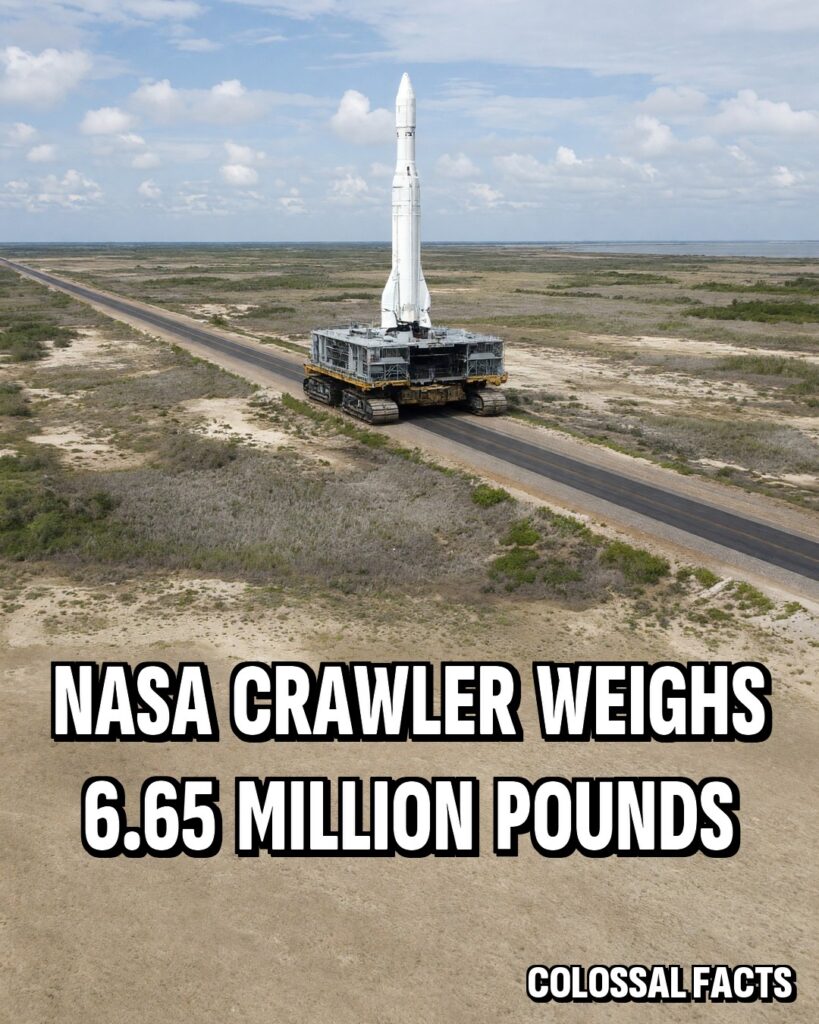
Two machines at NASA’s Kennedy Space Center in Florida still crawl the same road they were built for in the mid-1960s. They carry rockets, and the mobile launchers those rockets sit on, from the Vehicle Assembly Building to Launch Pads 39A and 39B. On 29 March 2023, Guinness World Records certified Crawler-Transporter 2 as the heaviest self-powered vehicle on Earth, at approximately 6.65 million pounds, or 3,016 metric tons. NASA compared that mass to about 15 Statues of Liberty, or 1,000 pickup trucks.
The pair was built by the Marion Power Shovel Company for the Apollo program. Construction ran from March 1963 to January 1966; the crawlers themselves date to 1965 in NASA’s own accounts. After Saturn V and Skylab, they spent three decades taking space shuttles to the pad. After the shuttle fleet retired in 2011, Crawler-Transporter 2 was upgraded to carry the heavier Space Launch System and its mobile launcher for Artemis missions to Pad 39B.
How heavy, and why that record still stands
NASA’s crawler pages and fact sheet put CT-2 at approximately 6.65 million pounds. The Guinness entry records the same figure and dates the weight increase to upgrades completed on 23 March 2016. The two machines did not start that heavy. As originally built, Guinness notes, they weighed around 2,700 tonnes, or about 5.95 million pounds. The work that prepared CT-2 for SLS replaced locomotive engines, strengthened systems, and added mass, which is why this crawler is now heavier than its sibling, Crawler-Transporter 1.
Larger land machines exist. Bucket-wheel excavators such as the Takraf Bagger 293 are bigger overall. They are not, however, in the same Guinness category, because they need an external power source. The crawlers generate their own power with locomotive diesel engines and large electrical generators. That is the distinction behind the title “heaviest self-powered vehicle.”
Size, speed and a level deck
Each crawler is about the size of a baseball infield: 131 feet long and 114 feet wide, or 39.9 by 34.7 metres. Height varies with the jacking, equalization and leveling cylinders, from about 20 feet to a maximum of 26 feet (7.92 metres). The vehicle does not carry a rocket directly. It picks up a mobile launcher, with the vehicle already stacked on it, and later withdraws down the crawlerway after the platform is locked at the pad.
The trip is only about four miles, or 6.7 kilometres, from the Vehicle Assembly Building to either pad, but it is slow on purpose. Loaded, the crawler typically moves at about 1 mile per hour, and a rollout can take around five hours. It was designed to travel 2 miles per hour (3.2 km/h) unloaded; NASA engineers have not tested that maximum. After the SLS upgrades, CT-2’s load capacity is 18 million pounds, 50 percent higher than the original design, or, in NASA’s comparison, more than 20 fully loaded Boeing 777s.
The deck has to stay level while the road is not. The crawlerway uses a river-gravel bed. There is a grade of about 5 percent on the approach to the pads. The hydraulic leveling system keeps the stack upright so that, at the top of a Saturn V, the permitted deviation was on the order of a foot, about 30 centimetres. Eight tracked trucks share the weight. The same basic layout that moved Apollo hardware is still the one that rolls out Artemis.
A machine built to outlast its first rocket
The surprising fact is not only the mass. It is that two 1960s tracked vehicles, rebuilt rather than replaced, still do the job for a new generation of Moon rockets, and that one of them now holds a world record because the upgrades made it heavier, not lighter. CT-2 will carry Mobile Launcher 1 and the Space Launch System from the Vehicle Assembly Building to Pad 39B. The certificate presented at Kennedy on 29 March 2023 simply put an official number on a machine that had already been famous for half a century: approximately 6.65 million pounds, moving at a walking pace, under its own power.
What the crawl is actually for
The Vehicle Assembly Building and the two pads sit a few miles apart because the rockets are stacked under cover and then moved, fully assembled, to the launch complex. That transfer has to be gentle. A stack that includes a mobile launcher and a Space Launch System core is not a load that can be hurried, and the crawlerway is not a highway. The gravel bed is designed to spread the weight of the tracks. The crew on board monitors grade, alignment, and the hydraulic system that keeps the deck level as the ground rises toward the pad.
NASA’s public fact sheet is careful about speed. The figure that visitors remember, about one mile an hour under load, is a practical pace, not a legal limit painted on the side of the machine. Analysis determines how fast a given stack can move while still giving the smoothest ride. The two-mile-an-hour unloaded design speed remains a number on paper. The five-hour rollout is the operational reality: a short distance, covered slowly, with pauses if wind, systems, or the roadbed require them.
The 18-million-pound capacity after the SLS upgrades is as important as the 6.65-million-pound vehicle weight. The crawler had to get stronger, and in getting stronger it got heavier, which is what pushed CT-2 into the Guinness book. The 29 March 2023 ceremony at Kennedy did not invent a new machine. It certified a mass that had already been published by NASA after the 2016 work. The original 1960s vehicles, at about 5.95 million pounds, were already giants. The Artemis-era CT-2 is the same family of machine, thickened for a heavier launcher.
Standing next to a crawler, the comparison with a baseball infield stops being a metaphor. The deck really is that broad. The tracked trucks at the corners can be steered in ways that let the machine crab or turn in a tight area around the assembly building and the pads. None of that changes the basic fact that made the record: under its own diesel-electric power, without a trailing cable, this one vehicle weighs approximately 6.65 million pounds and still crawls, as it has since the Saturn V years, from the Vehicle Assembly Building to Launch Complex 39.
Sources
- NASA – NASA’s Rocket Transporter Crawls Into History Books With World Record
- NASA – The Crawlers
- NASA – Crawler-Transporters Fact Sheet (PDF)
- Guinness World Records – Heaviest self-powered vehicle