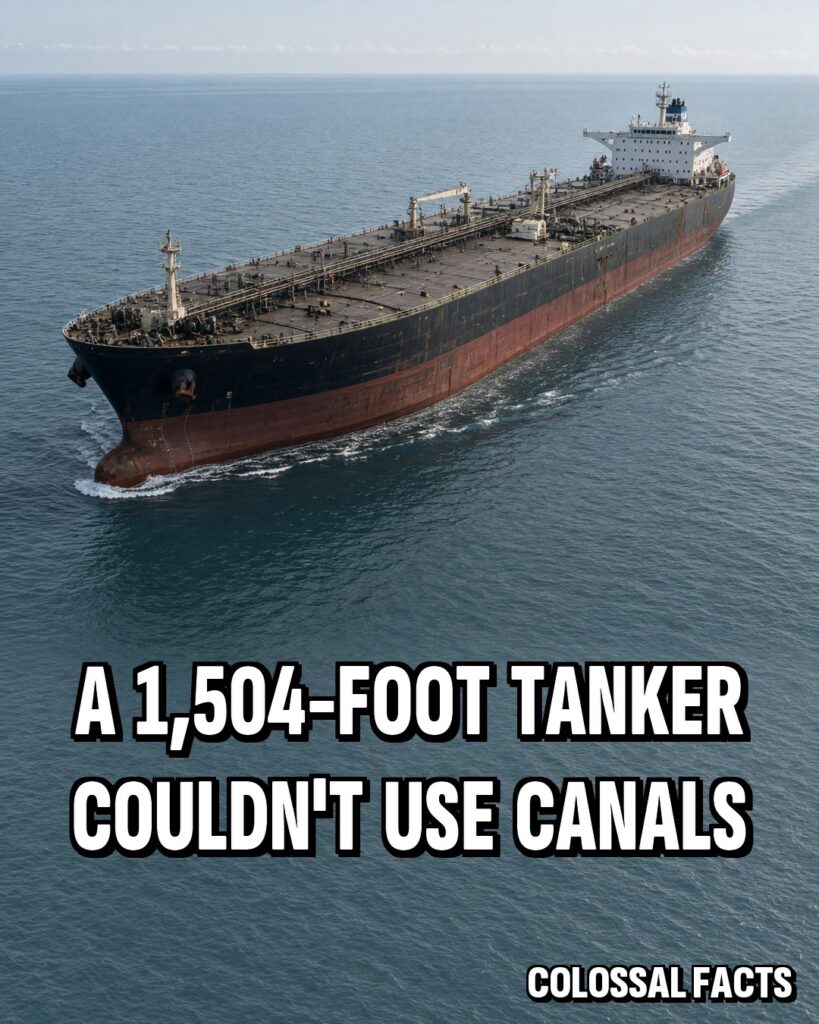
Seawise Giant was an oil tanker built by Sumitomo Heavy Industries in Yokosuka, Japan, and delivered in 1979 for the Hong Kong owner C. Y. Tung. A later extension, a jumboizing of the hull, made it the longest self-propelled ship ever built. It measured 1,504 feet (458 meters), or more precisely about 458.45 meters from bow to stern. Its beam was in the order of 69 meters.
It also held the record for the greatest deadweight ever recorded. Deadweight is the measure of how much cargo, fuel, supplies and other weight a ship can carry. Seawise Giant’s deadweight was about 564,763 tonnes. Fully loaded, it displaced about 724,000 US tons (657,019 metric tonnes). Its loaded draft was 81 feet (24.6 meters). That is how deep the hull sat in the water when the ship was full. Many ports, and all of the great canals, were simply too shallow or too tight.
The English Channel, the Suez Canal, and the Panama Canal would not let it through. Every trip began with a long run across open sea. The Cape of Good Hope was the practical road between oceans. Its service speed was about 19 mph (31 km/h), or roughly 16 knots. From full speed it needed at least 5.5 miles (8.9 km) to come to a halt. The crude oil aboard could fill about 1,500 Olympic-sized swimming pools.
A ship that was sunk, raised, and renamed
In May 1988, during the Iran–Iraq War, aircraft attacked the tanker near Larak Island, at the approaches to the Persian Gulf. Fire tore through the hull. The ship settled in shallow water and was declared a total loss. It did not stay there. Salvage crews raised the wreck, and it was rebuilt in Singapore. After that it sailed under new names: Happy Giant, then Jahre Viking. Later, as Knock Nevis, it no longer traded as a long-haul tanker. It was moored as a floating storage and offloading unit off Qatar, a steel island for crude rather than a ship on a voyage.
For the last trip it was renamed Mont. In 2010 workers cut it up for scrap at Alang, India, on the Gujarat coast, where many of the world’s largest ships are beached and taken apart by hand. Guinness World Records lists it among the largest ships ever scrapped. A few pieces were kept as souvenirs; the rest returned to metal.
Too long for the map’s shortcuts
No longer self-propelled ship has taken the length record. Later vessels have been built wide and deep for cargo, but not this long. The limits were practical: a ship that cannot use Suez or Panama, and that needs almost 25 meters of water under a full load, can call at only a few terminals in the world. Seawise Giant was a bet that crude would move in one enormous load, around the capes, at a walking pace, and that a hull this large would still pay its way.
It was longer than any ship before it, and too long for the great canals. For three decades the longest ship on Earth was a tanker that had been rebuilt after a war, renamed four times, and finally taken to pieces on a beach.
The name Seawise was a play on the owner’s company, Orient Overseas, and on C. Y. Tung’s initials. In the language of the trade the ship was an ultra-large crude carrier, a ULCC, built for the long crude runs that followed the oil shocks of the 1970s. Even after years of service and a complete rebuild, the hull still could not use the shortcuts that ordinary tankers take. A 24.6-meter draft and a length of more than 450 meters shut those doors. As Knock Nevis it spent its last working years almost still, a storage hull off Qatar, before the final name, Mont, and the beach at Alang. The longest ship ever built ended as cut steel, not as a museum.
Sources: Largest ship ever scrapped – Guinness World Records, Seawise Giant – Wikipedia, The Story of Seawise Giant – Marine Insight