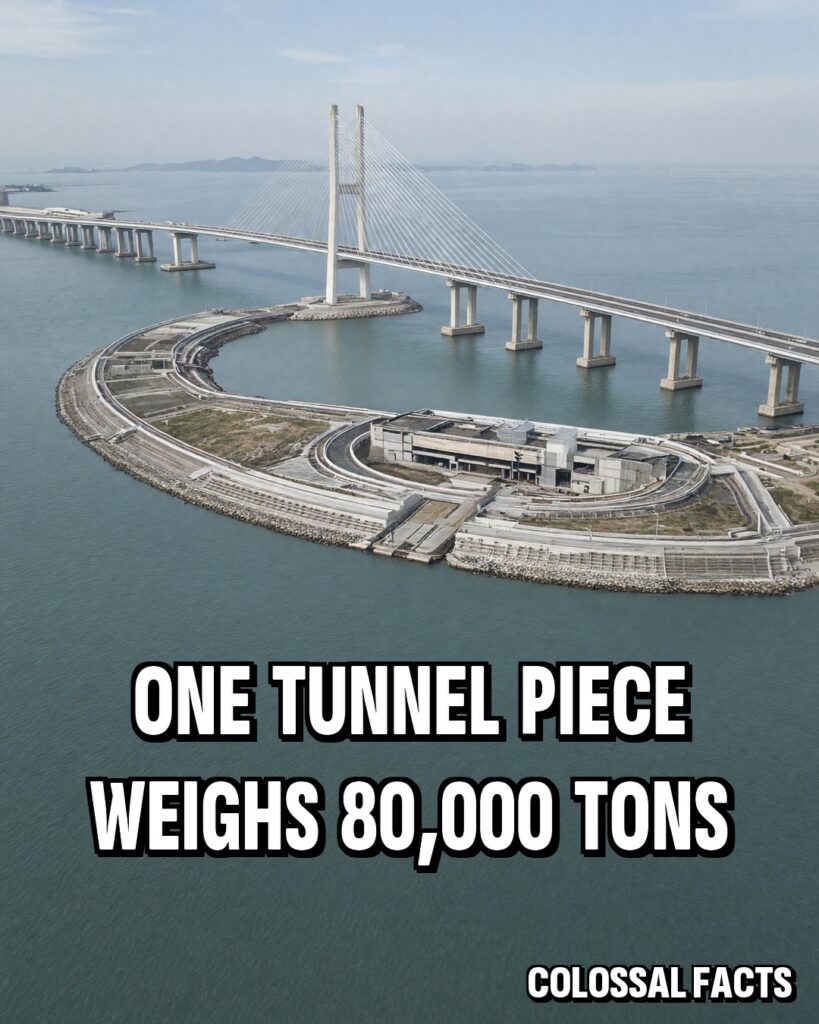
The Hong Kong–Zhuhai–Macau Bridge runs about 55 kilometers (34 miles) across the Pearl River estuary and links Hong Kong, Zhuhai, and Macau. Official descriptions call it the world’s longest bridge-cum-tunnel sea crossing, a permanent road over open water rather than a chain of ferries. Work started on 15 December 2009. The crossing opened on 24 October 2018. The main sea section is about 30 kilometers long: roughly 23 kilometers of viaduct and about 7 kilometers of sub-sea tunnel, joined by two artificial islands.
Halfway across, cars do not stay on the bridge. They enter a tunnel about 4.2 miles (6.7 kilometers) long between those two islands, so that large ships can pass overhead in the busy Lingdingyang channel. The navigation envelope was designed for very large vessels, including tankers of up to about 300,000 tonnes. The lowest part of the tunnel sits about 46 meters below the sea surface. The islands themselves were formed with huge steel cylinders and cover a total area of about 200,000 square meters.
An 80,000-tonne piece of road, lowered into the sea
The sunken tunnel was not bored through rock. It is an immersed tube: hollow concrete sections were built on land, floated out, lowered into a trench, and joined under the water. Official Hong Kong government figures say the tunnel is made of 33 giant segments plus a final closing joint. A standard segment is about 180 meters long, 38 meters wide, and 11 meters high, and weighs about 80,000 tonnes — as heavy as more than 13,000 African elephants, or roughly an aircraft carrier, piled on the seabed. The sections were precast on Guishan Island and towed to the site. Hydraulic jacks then had to shove each one into place with a tight tolerance. The final connection, a smaller steel-and-concrete joint of about 6,000 tonnes, was one of the hardest lifts of the job.
The road is a dual three-lane expressway with a design speed of 100 km/h. The link is built for a 120-year service life against typhoons, earthquakes, and a ship strike. Before this, the trip between the three cities went by ferry and took hours. From above, the crossing looks like one long bridge. Underneath, 80,000-tonne boxes of concrete hold the sea back, and the ships that once delayed the journey now pass over the road.
Three cities, two systems, one road
The project is more than a single bridge. It includes the sea crossing, ports of entry at each end, and link roads into Hong Kong, Zhuhai, and Macau — hence the official total of about 55 kilometers, longer than the 30-kilometer main span over the water. The three places sit under the “one country, two systems” arrangement, so the crossing also had to handle different traffic rules and border controls. Drivers do not simply roll from one downtown to another; they pass through ports, and in Hong Kong they drive on the left, which is why the Hong Kong section has to manage a change of side. The payoff is time. A journey that once meant a ferry of several hours can be done by road in about an hour, depending on the ports.
The 80,000-tonne segments are the detail that makes the tunnel possible in a shipping lane that could not be permanently blocked by piers. Factory production on Guishan Island let the pieces be built inland and floated out only when the weather and the trench were ready. The 120-year design life is a formal requirement, not a slogan, and it drove the waterproofing and the concrete mix. From the air the crossing is a line across the Pearl River. At water level it is a road that ducks under the ships and comes up on an island that was not there before 2009.
Sources: The world’s longest bridge-cum-tunnel sea crossing – Hong Kong SAR Government, Main Bridge – Hong Kong-Zhuhai-Macao Bridge, HZMB immersed tunnel – ITA Tunnelling Awards