The Large Hadron Collider is the world's largest and most powerful particle accelerator. CERN, the European Organization for Nuclear Research, operates it.
The ring crosses the border between France and Switzerland, near Geneva. It sits in a tunnel about 328 feet (100 meters) underground.
The tunnel was not dug for it.
The Large Electron-Positron Collider, called LEP, ran there first. The same circular tunnel was already complete when CERN built the new machine.
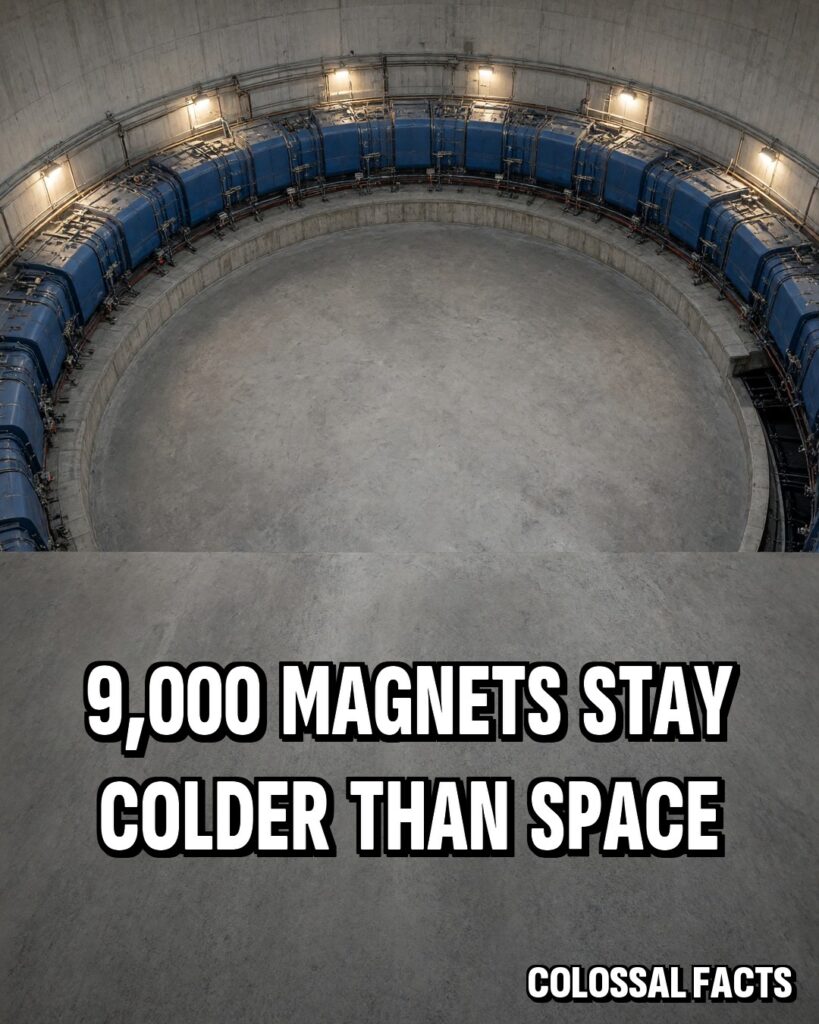
About 9,000 superconducting magnets line that circle. A superconductor carries electric current with no resistance when it is extremely cold, allowing it to produce a strong magnetic field.
Why so cold?
The magnets are cooled to 1.9 kelvin (-456°F), colder than outer space. The world's largest cryogenic system does the job. Cryogenics is the engineering of ultra-low temperatures.
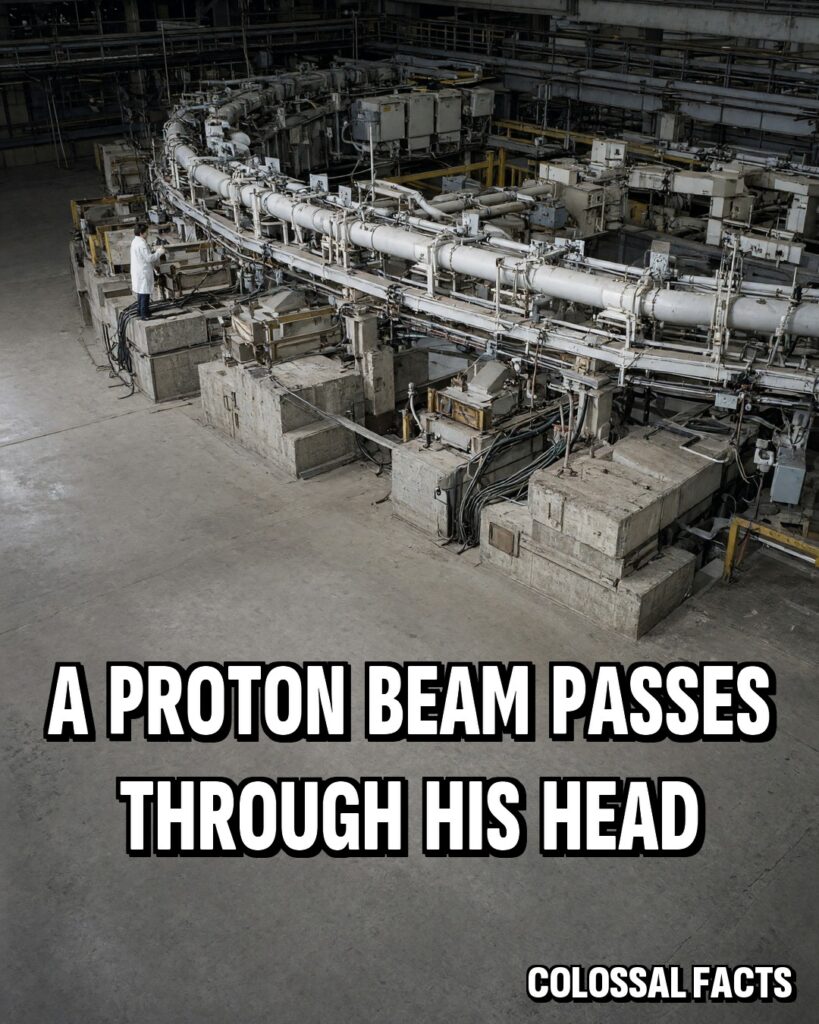
Two proton beams race in opposite directions, close to the speed of light, and collide. The dipole magnets that bend their paths are among the most challenging components to build and operate. Their magnetic field is about 100,000 times stronger than Earth's.
And those 17 miles (27 kilometers)?
That is about 297 American football fields laid end to end. The ring stays hidden under the border.
Ordinary ground passes overhead.
Under it, they measure what holds matter together.
Enjoyed the story?
Follow Colossal Facts for a new story every day.
Or watch them as short videos on Facebook →