The blue whale is the largest animal that has ever lived. The heaviest reach about 441,000 pounds, and some grow longer than 98 feet.
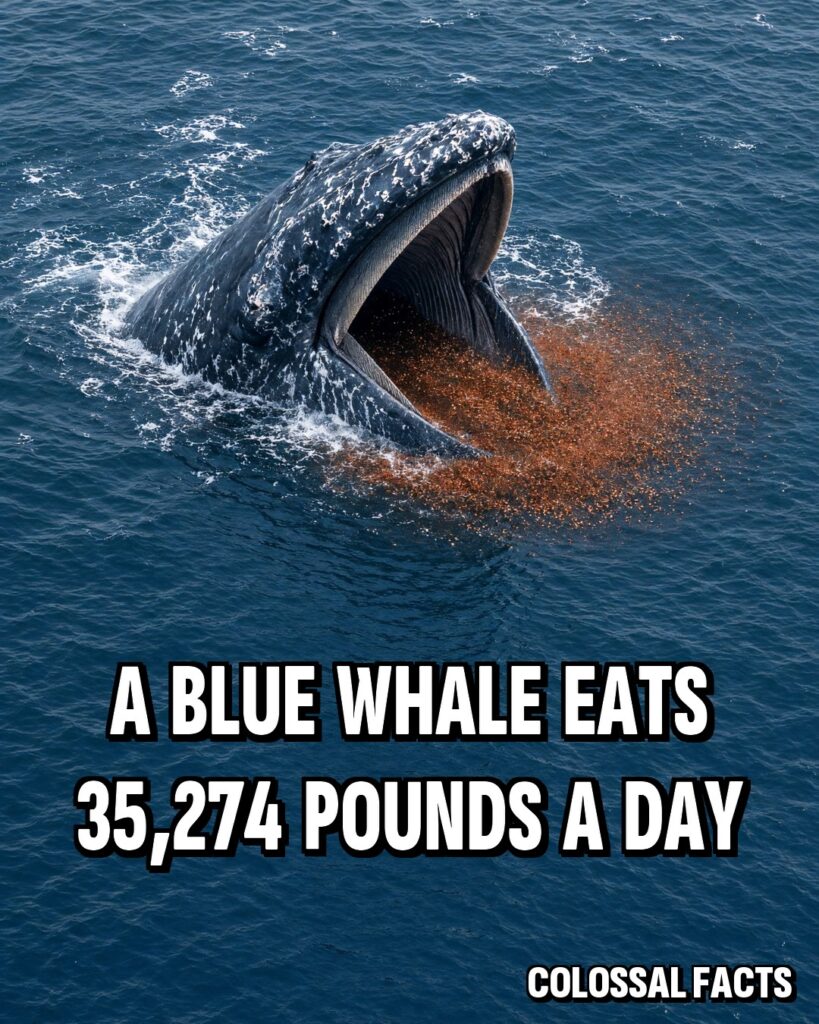
In the feeding season, one whale in the North Pacific eats about 35,274 pounds (16 metric tons) of krill a day.
That is about three times the old estimate.
Krill are not fish
They are tiny crustaceans, close kin to shrimp. Most are only a couple of inches long.
Krill feed on phytoplankton, microscopic algae that grow in surface waters. In turn, they feed fish, penguins, seals, and whales. Without them, much of the life in cold seas simply would not exist.
It is worth pausing on that: the biggest animal on the planet lives almost entirely on some of the smallest.
How does the whale keep them?
It has no teeth. In their place are baleen plates of keratin, the same protein as fingernails. They work like a sieve.
The whale swims into a thick swarm, opens its jaws, gulps water and prey, then pushes the water out.
Its throat is lined with long pleats that stretch like an accordion. In a single gulp, the whale can take in a volume of water comparable to its own body mass. Then the tongue and muscles force the water out through the baleen, and the krill stay inside.
Every lunge costs a lot of energy. So the whale does not look for just any krill. It hunts for the densest swarms. Otherwise the effort is not worth it.
The new math
Smithsonian scientist Nicholas Pyenson took part in the study behind the new figure. It was published in 2021.
Instead of relying only on calculations, the team put tags with cameras and motion sensors on whales and used echo sounders to measure how dense the krill were where the whales fed. That let them see how often the whales gulped and how much food came in with each mouthful.
The result showed that earlier estimates had badly underrated the appetite of the great whales.
That load weighs as much as a city bus.
One study uses that feeding-season figure. Another source finds about 8,818 pounds a day in some parts of the year. The gap comes from the fact that whales do not eat evenly all year. They bulk up in the feeding season and eat much less while migrating.
The whale as the ocean’s gardener
The whale sends iron back into the sea through its waste. Krill depend on those nutrients.
Iron is scarce in many parts of the ocean. When whales release it near the surface, phytoplankton grow better, and so do the krill that eat them. Whales do not only eat krill. They help make more of it.
The cost of whaling
Whaling in the 20th century cut global whale populations by about two-thirds.
The krill eaten by blue whales fell by 99.6 percent.
It sounds backward, but after the whales disappeared, krill in some regions did not boom. They declined. The fertilizer the whales carried was gone.
An international moratorium on commercial whaling has been in place since 1986. The blue whale, though, is still an endangered species, and its numbers are recovering slowly.
Fewer whales means less iron.
And less krill for the next generation.