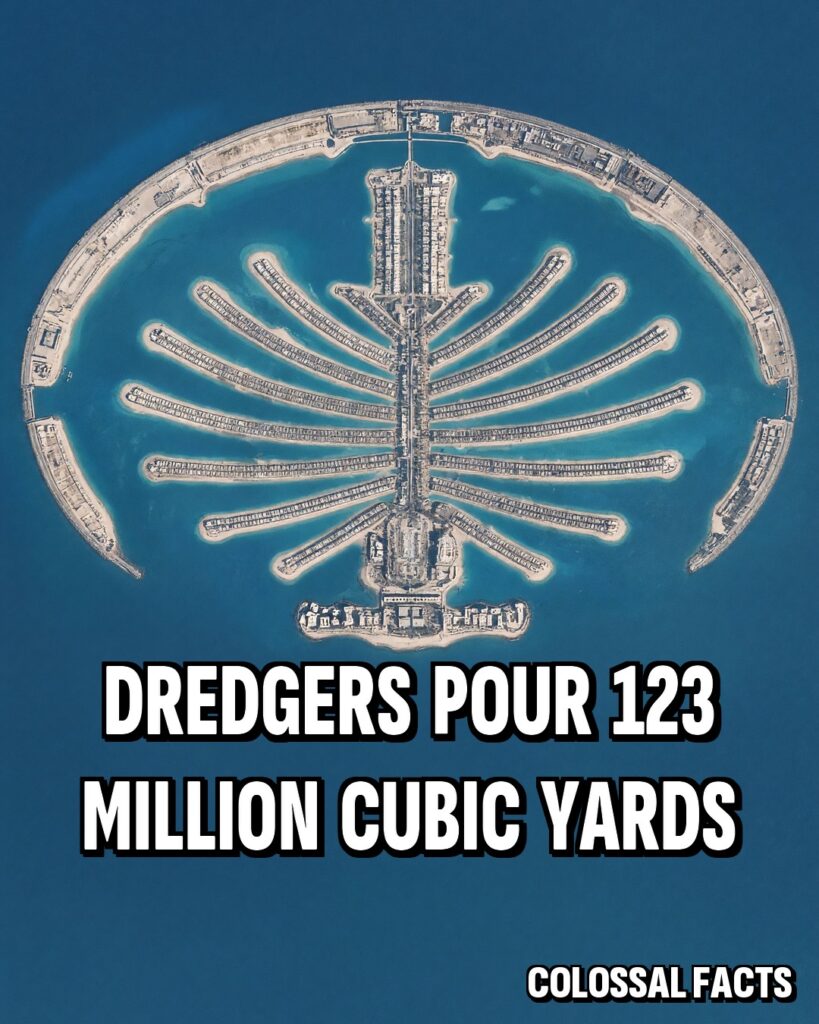
Palm Jumeirah is a man-made island shaped like a palm, poured into the sea off Dubai. From 2001 to 2008, Van Oord and Jan De Nul built it from sand and rock. No concrete in the base. No steel either. The structure is the fill itself, held by a rock breakwater.
The sand is not desert sand. Desert grains are too fine, and waves would wash them away. Crews take it from the floor of the Persian Gulf. Dredgers dump it by rainbowing: a jet of sand arcs through the air like a rainbow and falls where GPS aims it. A rock breakwater takes the sea’s hit and holds the new land in place.
Why a palm, not a circle?
That shape adds almost 35 miles of beach in a small area. The trunk, the crown and the frond-islands multiply the shoreline without turning the island into a huge disc. For Dubai this is both a map and a property plan: more frontage on the water, more addresses with a beach, more reason to buy before the houses are even finished.
The first 4,500 homes sold in less than three days. The island became one of Dubai’s most wanted addresses. The sand under the houses is still settling. It packs down under its own weight and the weight of the buildings. That is not, by itself, a hidden scandal. It is how a fill in the sea behaves, and engineers watch it. The new land is not bedrock. It is arranged sediment that grows denser with the years.
Those 123 million cubic yards (94 million cubic meters) could fill 37,000 Olympic pools. The figure explains why the project is told as engineering, not only as a silhouette on a postcard. The drawing is only the shape. The structure is the sand itself.
The sea does not agree easily
The breakwater is the duller and more important part of the story. Without it, the arc of sand would not last the first serious storm. The rock does not make the island pretty. It makes the island possible. Between the trunk and the protective arc, waterways have to be flushed so they do not stagnate. The same shape that sells beachfront also creates a hydraulics problem that has to be maintained.
Building in open water depends on weather, on the accuracy of the fill and on constant checks of elevation. GPS is not a toy. It is the tool that decides whether a palm frond will sit where the plan says it should. Rainbowing looks dramatic in photographs. In practice it is a way to place an enormous volume of material quickly and shape it before the next wave pulls it out of line.
Today Palm Jumeirah is a lived-in island, not a model. People sleep on sand that a quarter of a century ago still lay on the floor of the Gulf. That makes the project impressive and, at the same time, dependent: it exists for as long as the defenses, the maintenance and the settlement monitoring continue. The shape is a palm because that is how the shoreline is sold. The structure is sand and rock because only those hold that shape in the sea. The drawing is only the shape. The structure is the sand itself. Ninety-four million cubic meters are hard to forget, because without them the palm is only a logo. With them it is land the waves keep testing, and people keep inhabiting.
There is a second cost that aerial advertising shots do not show. The depth around the island, the flow in the canals and the breakwater itself all need constant care. Sand moved from the seabed does not come to a complete stop. That is why Palm Jumeirah is not “finished” in the sense that a concrete building is finished. It is a work the sea tests every season.
For a resident the island is an address and a beach. For an engineer it is fill, GPS points, elevations and a rock defense. The two views meet in the same palm shape. If the defense weakens, the shape blurs. If maintenance holds, those 94 million cubic meters remain land. That has been the wager of the project ever since the first arc of sand fell into the water between 2001 and 2008.
Sources: Van Oord, Jan De Nul, Nakheel