The Great Pyramid at Giza is the tomb of Pharaoh Khufu, also known as Cheops. About 2.3 million stone blocks were cut, hauled, and set into one mass. Most are limestone from nearby quarries. Granite came from Aswan, hundreds of miles to the south, and still had to meet the same schedule.
The job took about 20 years, while Khufu was still on the throne. How do you hold a deadline like that when each stone weighs about as much as two light cars?
One Block Every Two Minutes
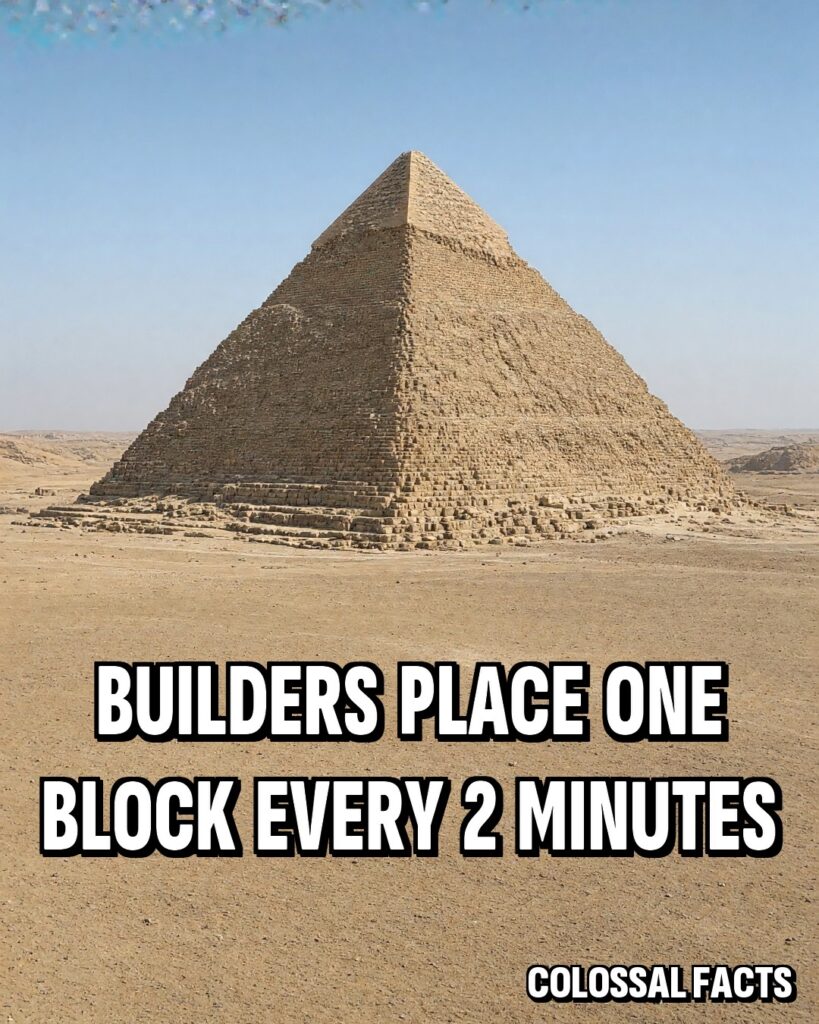
During working hours, crews placed one block every two minutes on average. Each stone had to be cut, delivered, and set before the next one was due. The quarry and the build ran on one clock.
The figure is arithmetic, not magic. Spread roughly 2.3 million blocks across about 20 years of work, and the average working-day pace lands near one stone every two minutes. Some blocks were smaller. Others were far heavier. Outer casing stones of fine limestone often weighed about 10 tons or more. Interior granite blocks in the chambers run up to about 50 tons.
The average block weighs about 2.5 tons — nearly two light cars. The pyramid’s total mass is estimated near 6 million tons. To keep that tempo, cutting, hauling, and setting could not wait on one another.
Limestone Close By, Granite From Aswan
The core came from limestone quarried on the Giza plateau itself. The fine outer casing came from the Tura quarries across the Nile. Granite for the inner chambers and galleries traveled from Aswan — on the order of 500 miles by river.
The stone was not dumped in a heap. Each block had to fit its neighbors. The base sides run about 756 feet (230.4 meters) and match to within a few inches. The corners are nearly perfect right angles. The face slope is about 51°50′. Alignment to the cardinal points misses true north by only about three minutes of arc.
This was surveying, repeated millions of times.
How Many People Built It?
For a long time the story pointed to 100,000 people — the figure Herodotus heard about 2,000 years after the build. That estimate is disputed.
Modern Egyptologists more often cite about 4,000 primary workers in the quarry, on the hauling teams, and at the setting face, plus 16,000–20,000 in support — food, tools, ramps, boats, administration. That puts roughly 20,000–25,000 people on site at a time. Mark Lehner, who excavated the workers’ settlement at Giza, puts the stone crew near 10,000 and the whole community near 20,000.
They were not slaves in the popular sense. Archaeology shows villages with bakeries, medical care, and craftsmen’s tombs — skilled labor, paid or state-supported, often in seasonal shifts.
Tallest for More Than 3,700 Years
In its first form the pyramid reached 481 feet (146.6 meters), including the lost capstone. The tip and much of the casing are gone, so it stands about 455 feet (138–139 meters) today.
For more than 3,700 years, no human structure stood taller. Only in the early 1300s did European Gothic cathedrals — among them Lincoln Cathedral — take the height record. By comparison, the Empire State Building rose in 410 days in 1930–1931 — another speed record, but with steel and elevators.
The Great Pyramid remains the only surviving Wonder of the Ancient World.
A Tomb on an Engineering Clock
It is a tomb, but its rhythm is engineering. About 20 years, about 2.3 million blocks, roughly 2.5 tons on average, a working-day pace near one block every two minutes, and a workforce on the order of 20,000 people — not 100,000 slaves.
The quarry cuts. The river carries. The ramp lifts. The course waits for the next stone — and the stone arrives on time.
Height made the record visible. The pace made it possible.
Sources: How Long Did It Take to Build the Great Pyramid? – HISTORY, The Private Lives of the Pyramid-builders – BBC, Excavating the Lost City – NOVA / Mark Lehner, Great Pyramid of Giza – Wikipedia