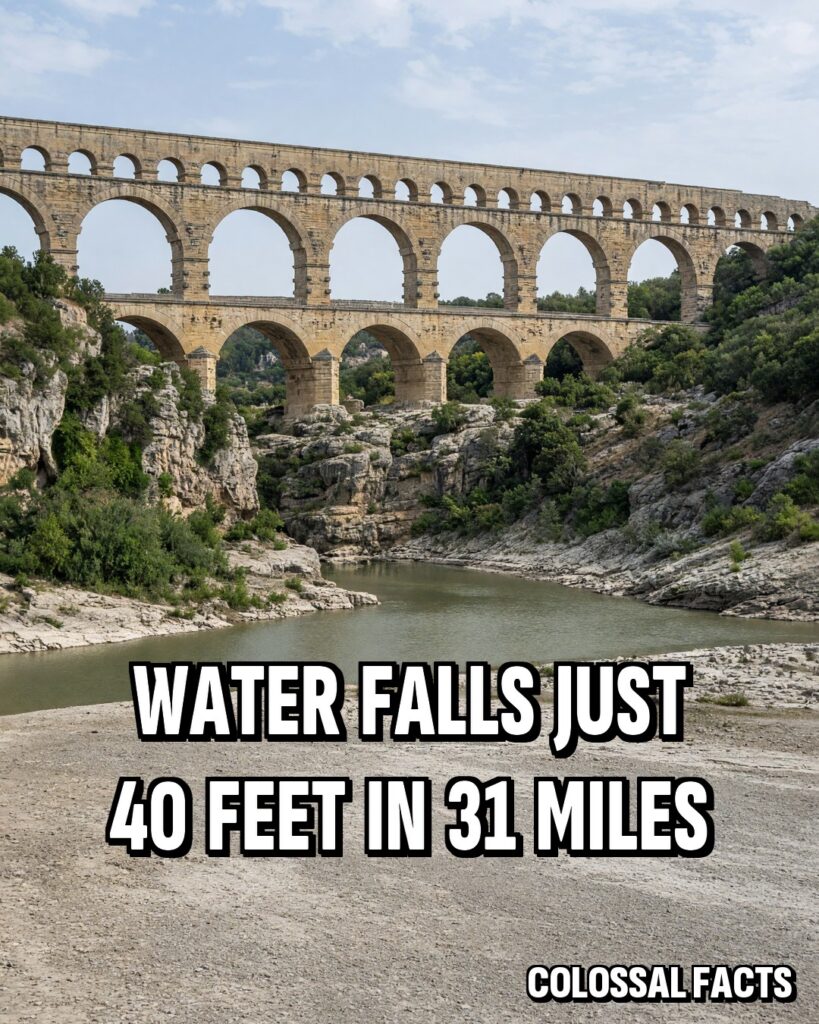
Pont du Gard is the striking part of the aqueduct that carried water to Nîmes. Romans built it around 50 AD. Water left a spring near Uzès and reached the colony of Nemausus. The full route runs 30.9 miles (49,702 meters). No pumps. Gravity does the work.
The average slope is 9.8 inches every 3,281 feet (25 centimeters per kilometer). For its time, that was one of the slightest grades ever achieved at this scale. Over the whole run the channel drops 40.3 feet (12.27 meters). To the eye, the fall almost disappears. That is the skill: keep the water moving, without letting it stagnate or race hard enough to chew up the masonry.
A fall the eye can barely catch
Those 9.8 inches every 3,281 feet come to about one seventh of a person’s height, stretched over that distance. Too gentle, and the water drains too slowly, stone is deposited, and the channel silts up. Too steep, and the flow wears away the floor and the walls. Engineers held the stream in that narrow range without modern levels, lasers or satellite maps. The fall is so slight the eye almost cannot catch it. The bridge stands like a stone wall over the valley. The real record is a slope you can barely see.
Each day as much as 1.4 million cubic feet (40,000 cubic meters) reached the city. The trip took 24 to 30 hours. Nîmes received that water for five centuries. For a Roman colony this was not decoration. It meant baths, fountains, households and the feel of a city that could afford abundant water, even though the spring sat tens of miles away.
Pont du Gard itself crosses the Gardon River with three tiers of arches. The lowest are the widest; the top tier carries the channel. The stones were fitted with extraordinary care. In the main structure there is no ordinary mortar in the sense we expect on a brick wall. Weight and fit hold the bridge. That is why it still stands after the aqueduct stopped feeding the city.
The bridge is the spectacle; the channel is the point
Most visitors come for the facade over the river. The logic of the work, though, is hidden in a thin gradient over tens of miles before and after the bridge. If that line goes wrong by a little, either the water never arrives or it arrives with destructive force. Roman surveyors carried the route through hills and valleys so that the average fall was preserved, even when the ground beneath it rose and dropped.
Nîmes took that water for five hundred years. Then the system declined, the channel silted up, and maintenance faded. The bridge remained because it had been built as a mass of stone, not as a temporary wooden crossing. Today it is among the best-preserved Roman aqueduct bridges and is listed as World Heritage. People pose in front of the arches. The record is not the height of the facade. The record is a drop of 40.3 feet across nearly 31 miles, and the 9.8 inches that, in every 3,281 feet, moved the water forward with no pump at all.
Too gentle does not work. Too steep does not work either. Between the two, the Romans found a band almost too thin to see, and held it for generations. Pont du Gard is the stone you notice. The slope is the reason that stone had a purpose in the first place.
Today people walk the bridge as a monument, not as a working channel. Water no longer arrives in Nîmes by this route, but the gradient can still be told in figures that have not changed: 49,702 meters of course, a drop of 12.27 meters, 25 centimeters in every kilometer. Those are measurements that can be checked, not a legend about a “nearly level” trough. Roman surveyors had to be exact, because a mistake would not have been forgiven over 31 miles.
Sources: Pont du Gard official site, Pont du Gard – UNESCO World Heritage, Pont du Gard – Encyclopaedia Britannica