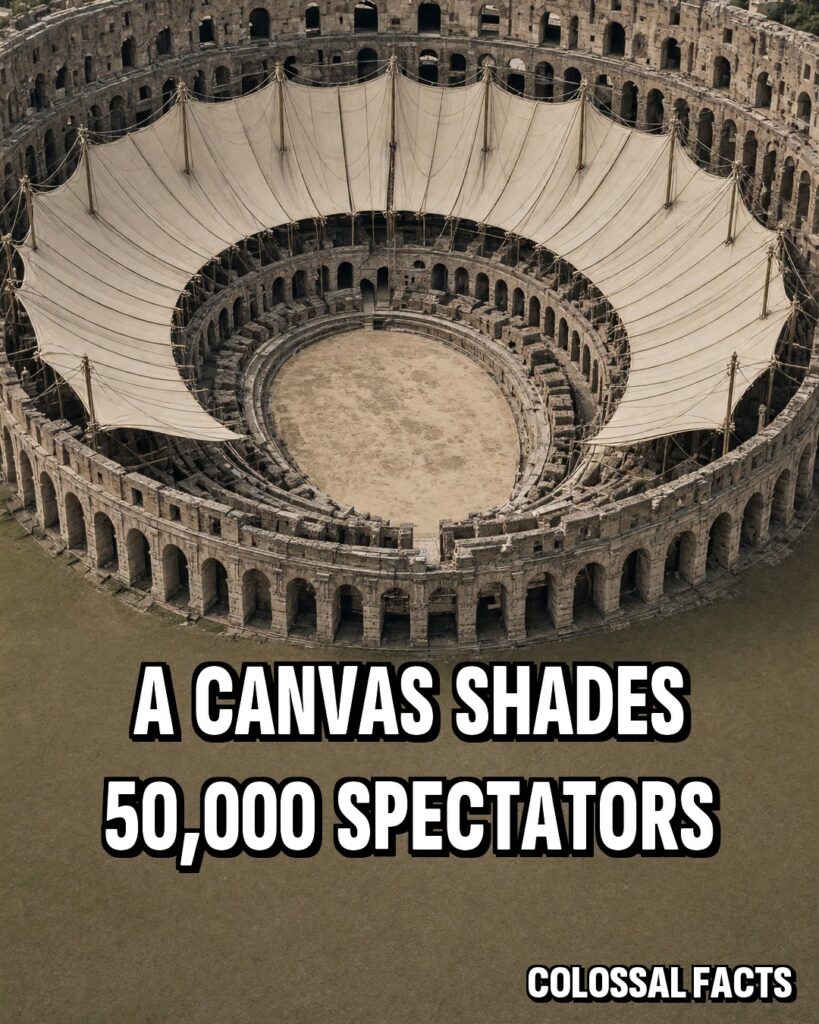
The velarium was a huge retractable canvas over the Colosseum. Sailors stretched a linen awning above the seats in the hot Roman summer. It shaded up to 50,000 spectators. It was not a roof over the whole arena. The system covered about one third of the area. It put shade on the seating rows and left the arena floor open. People closest to the fight got less cover from the sun.
Who pulled it tight? A permanent crew of sailors, moved from the Roman fleet at Misenum, near Naples. They handled the ropes and the sails, as they would on a ship, only this time above an amphitheatre. The awning hung from 240 wooden masts set in sockets along the top rim. Some of those sockets are still visible in the crown of the Colosseum. They are the clearest physical trace of a system otherwise made of wood, rope and cloth, all of it long gone.
Shade for the crowd, light for the sand
The open center let air move between the panels. That made a noticeable breeze for the crowd, while the arena stayed in the light. This was not a casual compromise. The show had to be visible. The public had to last for hours under an Italian sun. The velarium solved both problems: shade on the seats, light on the sand.
The canvas may have weighed as much as 24 tons. That is about four African elephants, except the load hung on ropes overhead. That is why the work belonged to sailors, not to ordinary building crews. They knew how to tension a sail, how to hold it in a wind and how to strike it before a storm tore it apart. On a hot, still day the system was a comfort. In a strong wind it became a risk.
The Colosseum held about 50,000 people. That is a city crowd packed into an oval of stone. Without shade, marble and masonry heat up, and the programme lasts a long time. The velarium was part of the same hospitality as the numbered entrances: the crowd had to get in, sit down and endure the day, not merely admire the facade.
The largest retractable roof of the ancient world
The system is often called the largest retractable roofing scheme of antiquity. Modern stadiums use hydraulics, steel and motors. The Romans had a navy crew, wooden masts and the geometry of ropes. The idea was the same: a roof that was not permanent, but could be spread when needed and taken in when it got in the way or became dangerous.
Not every reconstruction is certain to the last kilogram or the last square yard. Ancient writers mention the awning, the stone still holds the mast sockets, and engineers still debate the exact method of tensioning. What is solid is enough: there was shade over the seats, sailors ran it, and the arena was not sealed under a solid lid. Pictures of a fully closed cap over the Colosseum are closer to fantasy than to a careful reconstruction.
Shade for the crowd. The arena stayed in the sun. That division is the whole design. The Colosseum was built to be watched. The velarium was built so the watching could be borne. The 240 masts, the 50,000 people and the weight of the canvas are only numbers until they come together on a summer afternoon: stone, rope, shadow in the tiers and hard light on the floor where the action took place. It was the largest retractable roofing system in the ancient world, and it left its clearest signature not in cloth, which vanished, but in the empty sockets still cut into the rim.
Sources: Parco archeologico del Colosseo, Colosseum – Encyclopaedia Britannica, The Colosseum – World History Encyclopedia