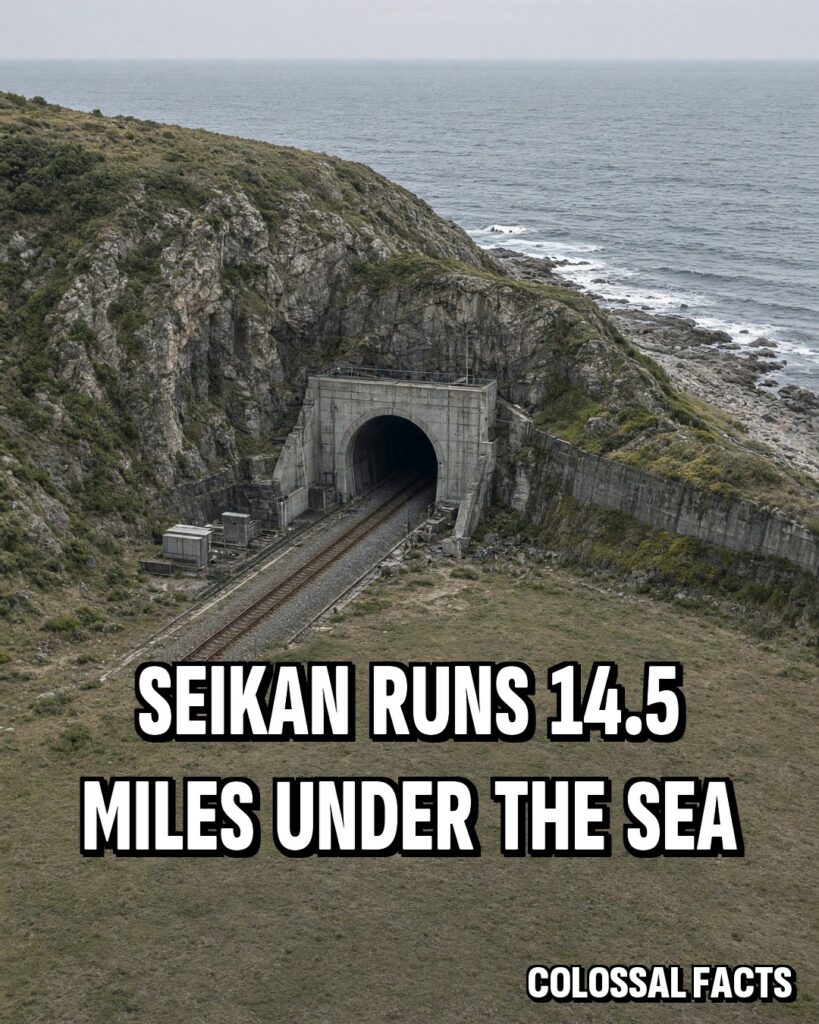
The Seikan Tunnel is a dual-gauge railway tunnel in Japan. It links Aomori Prefecture on Honshu with the island of Hokkaido.
Dual gauge means two pairs of rails in one track, so trains with different wheel spacing can use the same route.
It runs 33.5 miles (53.85 kilometers). Of that, 14.5 miles (23.3 kilometers) pass beneath the seabed of the Tsugaru Strait, and the tracks reach 787 feet (240 meters) below sea level.
It is the deepest railway tunnel below sea level.
Why dig it at all?
In 1954, a ferry sank there in a typhoon and took more than 1,400 lives. The disaster pushed plans for a tunnel that a storm could not shut down.
It opened in 1988.
Digging killed 34 people in cave-ins, floods, and other accidents.
By total length, it is the world's longest undersea tunnel, longer even than the Channel Tunnel.
Its stretch under the sea is shorter than the Channel Tunnel's.
The strait took the ferry.
The tunnel stays beneath it.
Enjoyed the story?
Follow Colossal Facts for a new story every day.
Or watch them as short videos on Facebook →