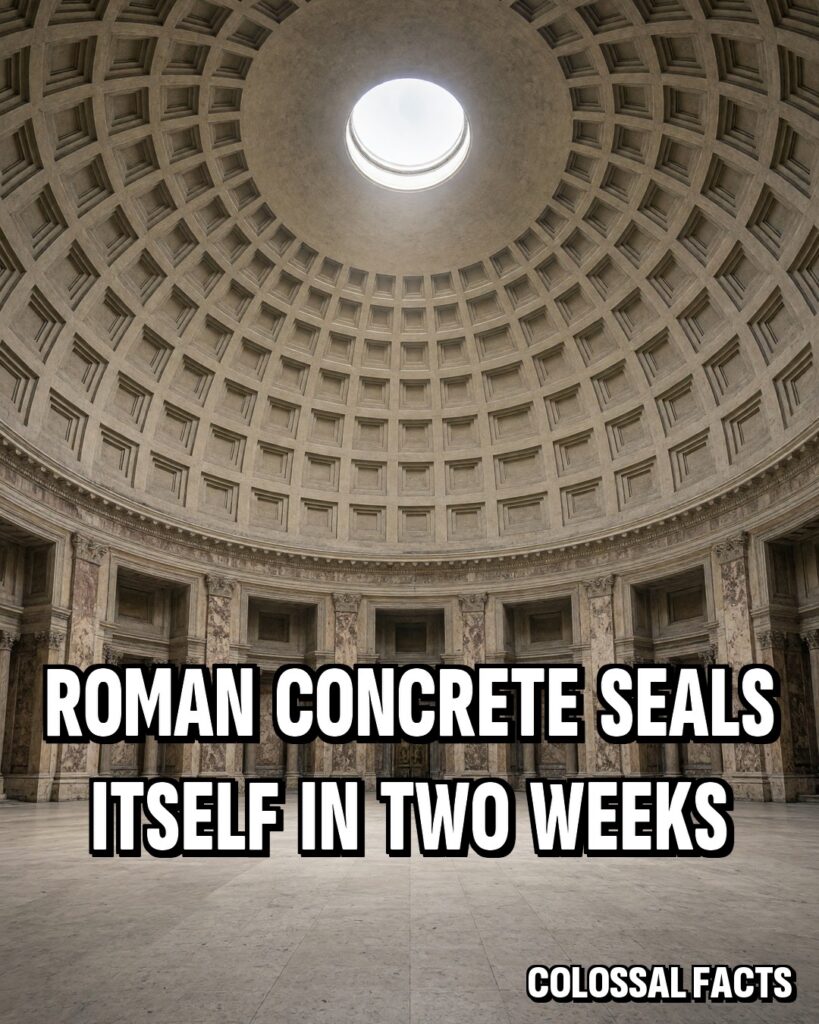
The Pantheon in Rome has the world's largest unreinforced concrete dome.
Dedicated in 128, it still stands intact.
The secret is not just age.
Builders mixed quicklime, a highly reactive form of lime, with volcanic ash. White lumps remained in the mix. Those clasts are leftover pieces of lime that stay reactive.
What does water do?
It enters a crack, dissolves the lime clasts, and triggers reactions that produce material to fill the split before it can spread.
In the lab, cracks close completely within two weeks.
The water stops.
The same sample without quicklime never heals.
The water keeps flowing.
The reactions start on their own.
So the concrete heals before a crack can threaten the structure.
A construction site in Pompeii, buried by the eruption of Mount Vesuvius in 79, provides evidence of the same hot-mixing method.
Admir Masic, an associate professor at MIT and coauthor of the study, calls Roman concrete durable, self-healing, and dynamic.
It has survived earthquakes, volcanic eruptions, and years under the sea.
A method from 2,000 years ago.
The dome still stands with no steel.
The cracks close on their own.
Enjoyed the story?
Follow Colossal Facts for a new story every day.
Or watch them as short videos on Facebook →